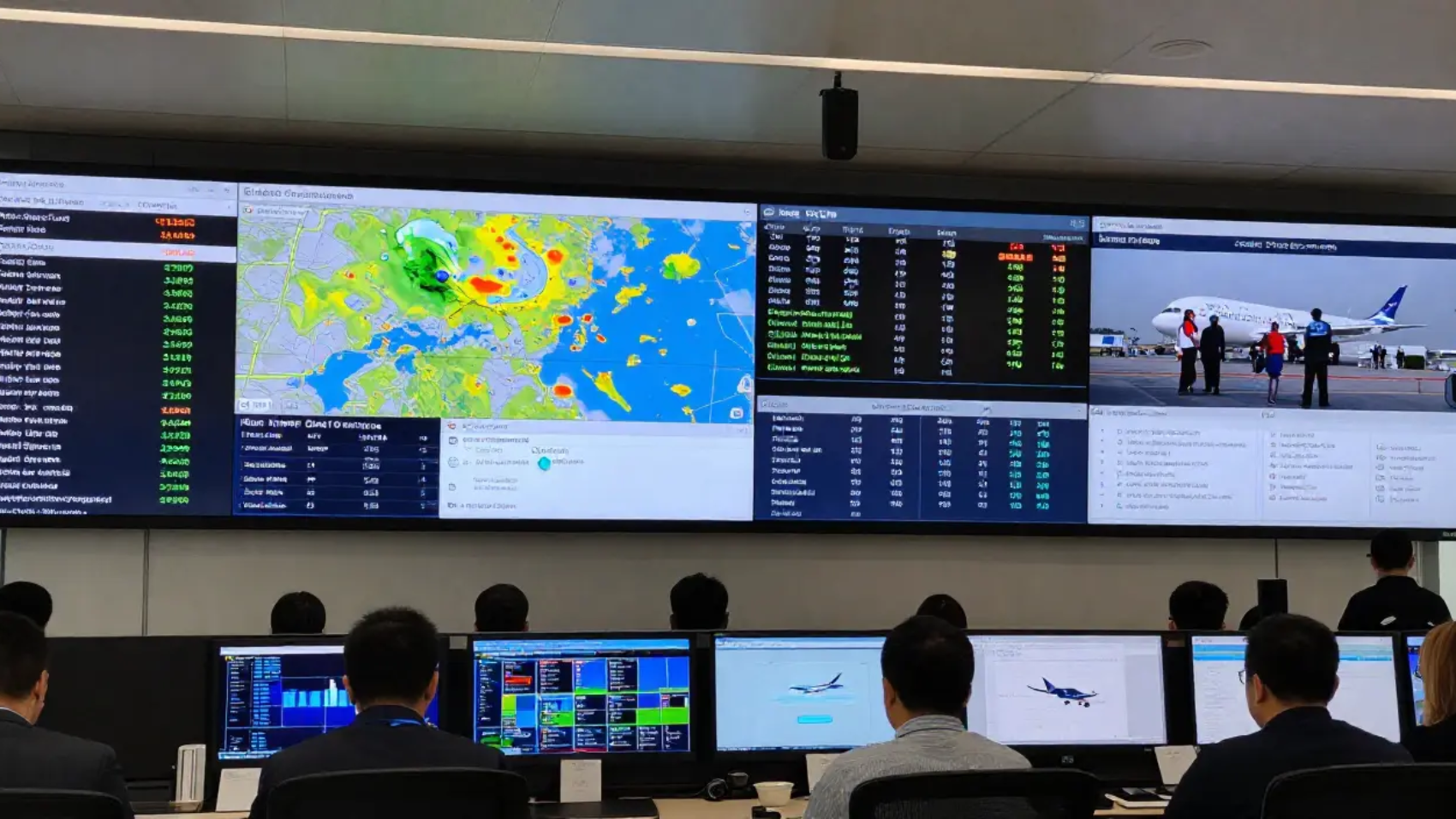


Enabling airline teams to predict operational disruptions and respond with smarter recovery actions.

How VoyagerAid Uses AI to Predict and Reduce the Impact of Operational Disruptions

Introduction: why prediction matters more than ever

Aviation operations deal with a variety of pressures every day. The operational environments of airlines are impacted by a variety of forces – weather fluctuations, congestion in the air traffic control system, aircraft maintenance issues and crew legality limits all have the potential to quickly disrupt an on-time schedule. When one flight has a delay; it is very rare that the delay will be contained to just that one flight. Rather, delays tend to cause a domino effect for both aircraft rotations, crew assignments and passenger connections resulting in an overall operational instability.

For many years, airlines have utilized a reactive approach to dealing with operational disruptions. When delays occurred, operations teams reacted to the delay trying to recover the airline’s operating schedule by rebooking affected customers and reallocating operational resources as quickly as possible. With the growing complexity of airline networks, this reactive approach has become inadequate.

Airlines have now started transitioning from a reactive approach to a predictive approach by using airline disruption management software. Rather than just reacting to delays after a delay has already occurred; airlines can invest in

systems that will allow them to proactively identify risks before they occur, analyze operational signals in real-time and initiate recovery actions before a disruption has an opportunity to escalate.

This is where the need for Predictive Disruption Intelligence comes into play. Through the use of artificial intelligence and operational data; airlines can predict upcoming disruptions and diminish the resulting operational and financial impacts.

Key takeaways 

  • Sometimes when there is an operational issue, it affects other parts of the airline’s operation, such as aircraft scheduling, crew scheduling, and passenger connections. Thus, the need for early identification becomes very important.
  • Using Predictive Disruption Intelligence allows an airline to find operational risk prior to delays or cancellations becoming more serious than necessary.
  • AI-enabled prediction systems evaluate many variables, including the weather, Air Traffic Control congestion, aircraft operational condition/health, crew legal limits, and airport capacity to help predict when disruptions might occur.
  • An airline can use modern flight delay prediction tools to help it be more proactive in predicting flight delays and preparing to recover from those delays.
  • Integrated airline disruption management systems connect predictive analytics to operational decision-making processes, allowing for improved recovery and coordination time.
  • By employing intelligent prediction tools through a flight disruption management system, airlines will reduce the effect of disruptions, protect revenue, and increase the passenger experience.

What is Predictive Disruption Intelligence?

Predictive disruption intelligence is an AI driven capability that enables airlines to anticipate operation disruptions before they occur. Instead of reacting to delays after they happen, predictive systems analyze real time operational data and historical patterns to identify flights that are at the risk of disruption. 

A predictive system simultaneously assesses various operational elements such as weather predictions, traffic delays, aircraft condition information, crew schedule limits and airport capacity restrictions to help spot trends that indicate the likelihood of a flight being delayed or cancelled by analyzing those multiple signals together using sophisticated predictive modelling tools.

Airlines will then be able to take proactive measures. Operations teams can modify their schedules, prepare contingency plans and work to assure that passengers can be booked onto another flight prior to the disruption spreading throughout the airline’s system. As part of an airline’s modern day disruption management systems, Predictive Disruption Intelligence provides airlines an effective means for facilitating operational integrity while reducing the overall impact of irregular operations on their system.

Why Airlines struggle to Predict Disruptions 

There are literally thousands of interconnected ‘variables’ that make up an airline’s network, with the operation of every single flight depending on many external factors such as: availability of aircraft, availability of crew members, weather conditions, airport capacity/operational capability, and air traffic control restrictions etc. Therefore, disruption to even one variable can lead to a domino effect of flight delays being accumulated throughout the airline network. 

Most traditional airline operational systems are set up more to monitor actual flight operations occurring presently (real-time) rather than facilitate limiting future disruptions of flights due to operational influences from the past (historical). Because of this most operational teams do not discover ‘problems’ until after flights have already commenced delaying on the ‘tarmac’.

A few examples of this situation can include: 

  1. An airport hub that will be affected by an incoming storm that causes numerous delayed flights.
  2. A delayed incoming flight due to maintenance delays affecting numerous downstream departures.
  3. A late inbound crew legally causing last minute flight cancellations.
  4. A busy airport causing delayed arrivals and departures on numerous flights. 

Airlines often do not have sufficient time to get their recovery plans ready before they run into a large amount of flight delays because they lack predictive insight into the operational impacts of all their interrelated variables. This is why so many airline companies are using ‘predictive intelligence’ tools as part of their new-age airline disruption management systems/processes. 

Predictive Disruption Intelligence:  The key to forecasting flight delays

With the use of Predictive Disruption Intelligence airlines are finally able to gain advanced/early notification of potential operational disruptions by being able to view large amounts of various forms of external data and quickly identify indicators within the data that may also signify an increase in operational disruptions with their airline.

These predictive systems utilize signals from the entire airline operational ecosystem. Rather than looking at one factor in isolation, predictive systems utilize multiple sources of data together to predict when to expect flight delays.

Key signals that predict Airline disruption
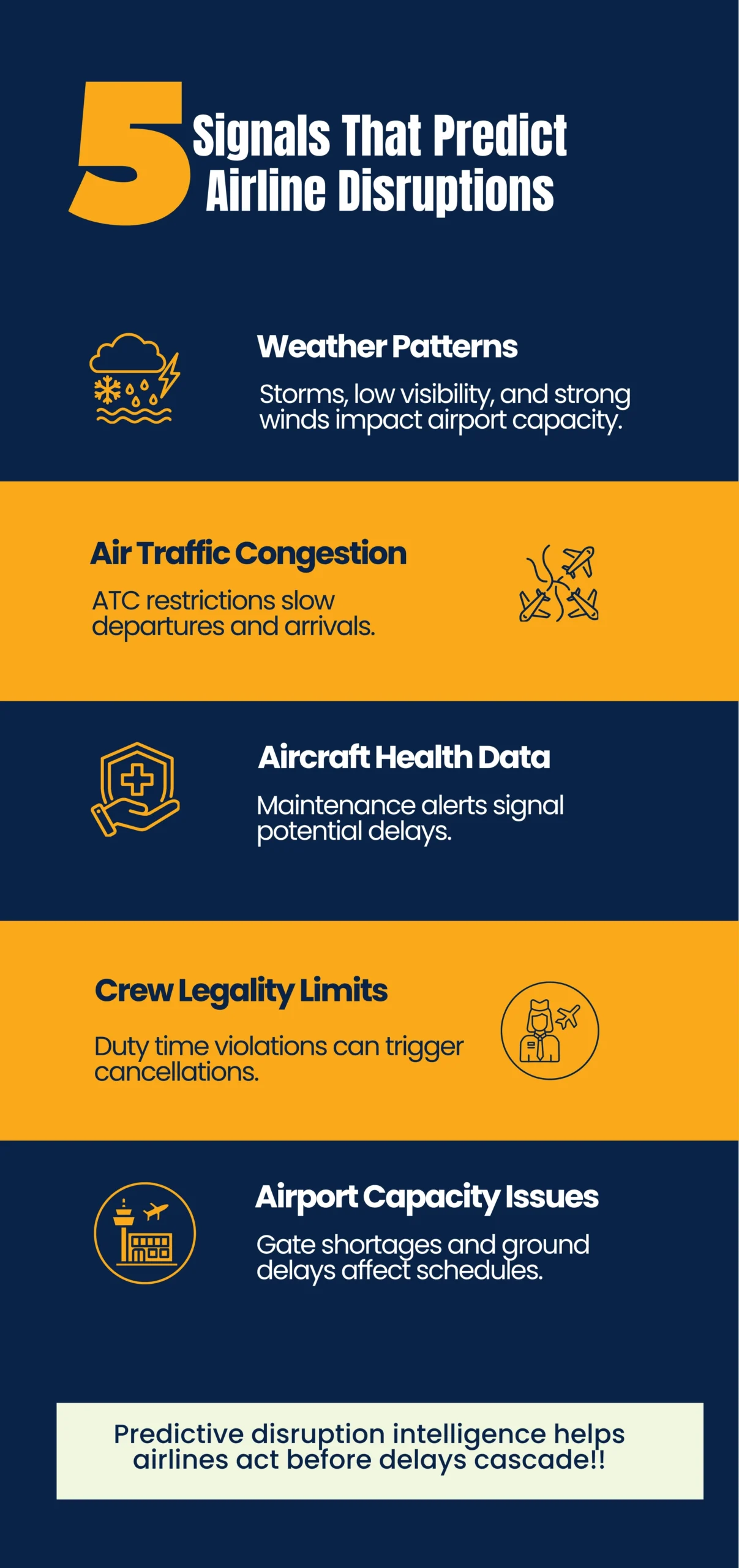
The infographic depicts five examples of major operational signals which often impact disruptions.

  • Weather patterns – Icy/stormy weather reduces airport capacity and increases risk of delay or disruption.
  • Air traffic congestion – Due to air traffic control restrictions/departure, arrival restrictions due to increased volume at busy hubs air traffic will slow.
  • Aircraft health data – Mechanical/software problems or maintenance alerts/aircraft data will illustrate problems for possibly delayed flight.
  • Crew legality Limits– Flight crew duty limits and rest period requirements prohibit some flight crews from flying scheduled flights due to legal limitations of operating hours.
  • Airport capacity Issues – Due to crowded gates/ground delays there are longer than usual turnaround times for aircraft.

When these signals are analyzed together, airlines gain a comprehensive view of operational risk.

Innovative flight cancellation/delay prediction software constantly looks at these five signals to identify flights with a high risk of experiencing delays. This function gives airlines advanced notice to prepare for flight disruptions before they spread through the operational network.

The use of artificial intelligence to predict airport flight delays in real-time has dramatically changed the way we think about scheduling.

How AI predicts flight delays in real time

By evaluating inputs from various sources, such as real-time weather information, airport traffic, aircraft operational data and crew scheduling data all of which may be affected by weather, AI can identify patterns that human analysts may not be able to see.

For example, if the weather at an airport is degrading and there are inbound flights that have already been delayed, an AI model can look at the weather and predict that the outbound flights from that airport will have a high probability of missing their scheduled departure time.

By identifying these potential disruptions earlier in the scheduling process, airlines have more time to create contingency plans, as well as to alter or eliminate operations that may be negatively impacted.

A key component of the modern flight disruption management system is the use of predictive analytics, which allows airlines to manage and avoid flight disruptions, not just manage them.

How VoyagerAid uses AI to predict and Reduce Disruption Impact

Airlines can effectively pre-emptively manage disruptions to their operations through VoyagerAid’s integrated Predictive Disruption Intelligence solution. The solution continuously captures operational granularly and at a global network level, enabling it to provide early identification of pertinent operational conditions that could lead to a delay or cancellation of flight(s).

When a condition that poses a risk is identified, VoyagerAid highlights which flights are affected and outline how that risk will impact subsequent operations; i.e., aircraft rotation, crew assignment, passenger connectivity, etc. This early detection provides opportunities to proactively evaluate various recovery methods prior to the disruption impacting operational flows.

Incorporating predictive analytics with intelligent decision support, VoyagerAid allows operations teams to simulate various recovery methods directly within the integrated application, rather than performing manual comparisons on an exercise by exercise basis (i.e., comparing schedules and operational constraints). Recovery methods could include aircraft and/or crew swaps or schedule modifications, all contributing to the ongoing stability of airline networks.

Being a fully integrated airline disruption management system, VoyagerAid provides a comprehensive evaluation of recovery options, based upon numerous simultaneous operational considerations.

Aligning passenger Recovery with Predictive Intelligence

By predicting disruptions earlier, the airline industry is able to better serve their customers and provide more efficient recovery procedures. For example, by identifying potential delays before they occur, airlines can be prepared with alternative options for re-accommodating their customers.

With automated identification of affected passengers, airlines are able to create a plan for passenger rebooking/accommodation prior to the full impact of the disruption taking place. As a result, there is less last minute re-accomodation and better control over passenger flow.

Utilizing integrated predictive forecasting/breaks within a company, will allow them to make decisions about how to recover passengers that align with operational constraints, thus eliminating rebooking onto flights that will be robbed of their capacity later, due to mechanical or crew-related issues.

Developing a link between predictive analytical data and passenger workflows through VoyagerAid will provide a more efficient and effective recovery experience.

Improving Operational Visibility through Data and Analytics

VoyagerAid also offers analytics on disruption patterns to assist airlines with operational analytics beyond real-time forecasting.

Operational dashboards allow airlines to examine the following:

  • Causes of delays and cancellations
  • Recovery effectiveness by route or hub
  • Operational bottlenecks affecting scheduling
  • Passenger recovery timelines

These analytics provide airlines with the information needed to continuously improve their disruption management strategies.

As part of an airline management software ecosystem, these analytics change the way airlines approach disruption management from reactive to proactive through the use of data-driven operational knowledge.

Conclusion : Turning prediction into operation advantage

There will always be operational interruptions within the aviation industry. Weather patterns shift when weather systems change; an aircraft must be repaired if they require maintenance; unanticipated restrictions can affect air traffic flow due to regulatory changes. Resilient carriers are those who accurately anticipate or mitigate anticipated operational disruptions by using advanced technologies and techniques.

Airlines now have access to advanced predictive technologies that allow them to manage their responses to operational disruptions through proactive planning. By reviewing and monitoring potential indicators of operational problems prior to actual occurrences, carriers can implement recovery plans faster when an issue arises than they could using pre-existing procedures.

VoyagerAid is an integrated software solution designed to streamline a carrier’s ability to recover following any type of operational disruption. By consolidating Predictive Disruption Intelligence with other operational processes, VoyagerAid enables an airline to better identify potential causes of operational issues, thus allowing them to reduce and contain the impact of disruptions.

If a carrier can predict an operational disruption and take corrective actions prior to that disruption manifesting itself, it provides them the ability to manage their operational network without interruptions caused by delays.

Revenue leakage tracking during airline IROPS disruptions.

Stopping Revenue Leakage During IROPS – A Guide for Airlines

Introducing the Hidden Cost of IROPS (Irregular Operations)

Irregular operations are unavoidable in the aviation industry. Weather changes, crew legality, aircraft swaps, Air Traffic Control restrictions, and technical faults are all part of the day-to-day operations for any airline. However, the amount of revenue lost due to operational disruption is not a given.

Airlines can see how much they have lost due to disruptions as a direct result of the costs associated with an operational disruption (compensation to passengers, hotel accommodations, rebooking expenses, etc.). However, there are also larger indirect costs associated with operational disruption that airlines will often overlook (revenue not collected or recovered, inefficient crew scheduling, empty seats created on re-routed flights, and delays due to manual decision-making).

Airlines do not lose money because of the operation of IROPS but because they are poorly coordinated and/or systemically unaligned.

Therefore, many airlines today are investing in integrated, and centralized airline disruption management software. Airlines need to stop the loss of revenue due to operational disruption by providing visibility of the entire crew on each aircraft as well as each customer, rather than only being able to respond (or fight fires) as they occur.

Let us look at how the airlines can lose money when operating under IROPS and the solutions that will correct these losses.

Revenue Leakage during IROPS: Where airline loses the revenue most

Revenue leakage will result from multiple small cumulative failures that impact the overall airline operation.

1. Inefficiencies with Passenger Reaccommodation

If an airline experiences a cancellation or significant delay on a flight, passengers need to be reaccommodated as quickly as possible. Unfortunately, using manual verification processes can lead to:

  • Open seats on flights that do have available capacity.
  • High value (premium class) re-accommodated onto a competitor’s flights unnecessarily.
  • Paying excess compensation to customers because airline representatives conducted poor eligibility reviews.
  • Issuing duplicate hotel or meal vouchers.
  • Missing out on recovery of ancillary revenue.

Without the use of an automated passenger re-accommodation and re-accommodation process, the entire process becomes reactive rather than optimized for the customer and the airline.

Many airlines do not have integrated management systems for handling flight disruptions. Consequently, it is difficult to manage both cost control and recovery for the customer. Poor balance between these two items directly contributes to the erosion of revenue.

2. Excessive Compensation and Policy Mismanagement

Many airlines operate under the existing regulatory framework that requires compensation for certain types of disruptions; however:

  • Compensation is too broadly applied.
  • Airlines frequently do not validate the eligibility of passengers for compensation in real time.
  • Airlines overpay due to the backlog in manual reviews for compensation.
  • Airlines have no reasonable Management Control System for airline passenger compensation.

When airlines do not have structured management software for airline compensation, payouts can spiral out of control beyond what regulations actually permit. Revenue leakage associated with compensation is not always easy to identify; however, magnitude can be substantial, especially when airlines experience large-scale IROPS events (e.g., hurricanes, floods, etc.).

3. Crew Legality Cascades

Crew is one of the most expensive operational assets for an airline. During a disruption, the following crew expenses will occur:

  • Duty time exceedances will cause disruptive crew swaps at the last-minute.
  • Crew on standby will be activated unnecessarily.
  • Crew pairings that are not aligned will create downstream cancellations.
  • The cost of deadheading crews will increase.
  • Poor coordination between crewing and OCC will increase the disruption footprint.

When crews are managed in isolation, airlines incur costs associated with overtime, repositioning crews, and cancellations that could have been avoided.

4. Aircraft Utilization Breakdown

Aircraft are revenue-generating assets for an airline. During IROPS, the following issues arise as a result of poor aircraft utilization:

  • Idle aircraft will result from poor swapping decisions.
  • Maintenance buffers may be miscalculated.
  • Delays in the turnaround of aircraft will block subsequently scheduled high-yield routes.
  • The cumulative network effect will reduce load factors across all subsequent flights.

Without a fully integrated ecosystem of management software, aircraft recovery decisions may unintentionally incur lost revenue over the next 24 to 72 hours.

5. Missed Opportunities and Communication Gaps

There are several ways that passenger revenue can be lost due to missed opportunities, including:

  • Passengers abandoning a booking because there is no update on their itinerary
  • Passengers flooding the call center and driving up staffing costs
  • Passengers who miss the opportunity for a recovery flight
  • Passengers who opt for a refund instead of rebooking

The lack of effective communication with passengers during the IROPS (irregular operations) period negatively impacts revenue retention.

When IROPS notifications are automated, and processes that react to IROPS are intelligent (e.g., use of algorithms), revenue loss from refunds can be greatly reduced.

The Real Issue: Siloed Disruption Management

The primary cause of most revenue losses from IROPS is the fragmented nature of disruption management:

  • Crew systems do not communicate with each other
  • Airline systems do not communicate with each other
  • Passenger re-accommodation tools do not communicate with each other
  • Compensation processes are manually completed
  • Decisions are made separately as opposed to as a whole

For these reasons, airlines are transitioning towards comprehensive airline disruption management systems that provide operational visibility and financial accountability in one solution.

The solution : An integrated approach to stopping revenue leakage

Stopping revenue leakages requires coordination among three dimensions which is Passenger, crew and Aircraft.

1. Intelligent Passenger Reaccommodation

Modern disruption platforms provide the following capabilities:

  • Automated rebooking based on cost optimization. 
  • Prioritized protection for the highest value passengers. 
  • Real-time seat inventory visibility.
  • Self-service reaccommodation portals. 

Airlines can keep their customers rather than lose them to refunds or competitors by using structured reaccommodation flight logic.

Integrated platforms can also streamline how airlines manage passenger compensation, which allows for compensation in accordance with airline policy instead of being paid out of panic.

2.Policy Controlled Compensation Automation

One key to protecting revenue is to enforce the rules.

The advanced software used by airlines to manage compensation efficiently ensures the following:

  • Automated eligibility checks
  • Compliance with all necessary regulations in the region
  • Controlled issuance of vouchers and hotels.
  • Prevention of duplicate compensation.

The potential for revenue leakage diminishes significantly when compensatory determinations are made based on systems, as opposed to manually reviewed under extreme pressure.

3.AI Driven Crew Recovery Optimization

Creating crew recovery solutions that don’t result in additional revenue loss should be the goal.

Modern systems can provide the following capabilities, which assist with crew recovery and maintaining operational flow:

  • Visibility of crew legality in real-time
  • AI-based pairing suggestions
  • Downline rotation simulation
  • Reduction of overtime activation

By incorporating crew decision-making into the larger airline-wide disruption management process, airlines reduce the likelihood of chain-reaction cancellations resulting in lost revenue.

4. Recovery of Aircraft with Awareness of Revenue

When making decisions about airplane swaps and routing, the following factors must be considered:

  • Seat load factor
  • Passenger yield
  • Network impact
  • Aircraft maintenance constraints

Software for managing the integrated disruption processes of an airline looks at the recovery of an aircraft from both an operational and financial perspective.

This will eliminate idle aircraft, misaligned rotations of aircraft and cancellation of profitable flights.

5. Communication of Real-Time Information to Passengers

An effective real-time airline notification system must provide:

  • Automated notifications of IROPS
  • Notification of reaccommodation options
  • Reduced call centre overload

With flight status alert notifications, passengers will increase their confidence in the airline, therefore reducing the number of refund requests and protecting revenue from future customer loyalty.

VoyagerAid : An unified platform to Prevent revenue leakage

VoyagerAid’s approach to disruption recovery involves addressing three areas that are closely related:

  • Passenger Reaccomodation
  • Crew Legality Management
  • Aircraft/Equipment Swap

Rather than analyzing these areas independently, VoyagerAid combines them into one cohesive system for managing airline disruptions.

The VoyagerAid system allows for:

  • Automated simulations of recovery using AI
  • Integrating passenger rebooking/accommodation processes into one workflow
  • Providing a policy-compliant way to automate compensation payment to passengers
  • Performing real time analysis of crew legality
  • Visualizing the impact of aircraft swap on recovery
  • Communicating automatically with passengers

As a result of this alignment between operational actions and financial consequences, VoyagerAid reverses disruption recovery from reactive cost mitigation into proactive revenue preservation.

For airlines that utilize integrated solutions for managing airline disruptions, such as the VoyagerAid solution will provide insight into both the “what is the solution to fix the flight” as well as the “what will be preserved in revenue”.

Conclusion: Revenue protection starts with Smarter Disruption Management

There will always be IROPS. The weather can change, crew members will exceed duty time limits, and aircraft will require maintenance and are unable to fly. 

However, airlines can stop losing revenue while their operations are disrupted by investing in modern airline disruption management solution, centralized airline disruption management system, and integrated flight disruption management system. 

Revenue leakage occurs during disruptions due to fragmented systems, manual compensation processes, disconnected crew recovery and reactive passenger handling. To avoid revenue leakage, airlines must coordinate intelligently between passengers, aircraft, and crews, which requires more than just controlling costs. 

Disruption management has evolved from being a fire-fighting operation to being a revenue protection strategy for the airline. This change creates competitive advantage in today’s margin-driven aviation environment.

Passenger using a smartphone for self-service rebooking at an airport during flight delays and cancellations.

Why Self-Service Is Now Mandatory for Airline Disruption Management

Airline disruptions have joined the mile-high club of expected inconveniences in modern air travel. Weather shifts, airspace congestion, maintenance challenges, and crew availability can cause unexpected interruptions at any moment. While the airlines continue to strengthen operational resilience in every way, one truth has emerged across the industry: passengers demand immediate control the instant their plans are affected.

Today’s passengers will not wait in queues or sit on long calls to understand their options. They want clarity on what their options are, a chance to make their own choices, and the ability to act then and there. This has changed how airlines think about disruption management-and it has made self-service a must-have capability rather than a nice-to-have add-on.

In that sense, modern airline disruption management software recognizes self-service as an integral part of the recovery workflow, making what earlier was a feature of support into a core operational function.

Overview The two main tasks when describing structure are stating positions and depicting orientation.

  • It eliminates bottlenecks and passenger frustration during disruptions.
  • Passengers prefer digital autonomy rather than dependence on airport service desks.
  • It cuts down on workload, speeds up the process of recovery, and improves satisfaction among airlines.
  • Real-time automation ensures that communication is consistent and accurate.

Today, self-service is a basic requirement of disruption strategies.

What is a Self-Service Portal?

A self-service portal is a digital platform which empowers passengers to independently manage each and every disruption-related action. As opposed to relying on customer service teams, passengers can now:

  • View disruption information
  • See alternative travel options
  • Rebook their journey
  • Select vouchers or refunds
  • Access updated documents
  • Keep informed about every step of the process.

The portal connects directly with airline systems to enable accurate and timely updates. It enables self-service reaccommodation that empowers passengers to resolve disruptions instantly with confidence.

Self-service portals have become a must because they offer speed, transparency, and reliability-all qualities passengers now consider more essential than optional.

Why Self-Service Has Become Mandatory in Disruption Management

1. Passengers Expect Immediate Control

Travelers of today are used to managing everything pertaining to their journey on their devices. When a disruption happens, the need for self-management reaches an entirely new dimension. Self-service gives passengers the ability to understand their options without delay.

2. Manual Processes Cannot Scale During Irregular Operations

Traditional workflows heavily rely on airport desks and call centers, which get clogged with calls during disruptions. Self-service portals distribute the pressure, enabling passengers to handle routine adjustments all by themselves.

3. Speed Defines Passenger Satisfaction

During disruption scenarios, delayed information engenders frustration. With self-service, passengers can take action the minute that they get an update, a feature that bolsters their confidence in how an airline approaches the handling of the situation.

4. Accuracy and Consistency Improve

Manual decision-making during high-pressure events can introduce variation. Self-service ensures every passenger receives consistent, policy-aligned options without the possibility of miscommunication.

5. Operational Teams Can Focus on Complex Cases

It means that when routine re-accommodation is automated, customer service and operational teams are freed to focus on passengers who genuinely need human support.

This fits naturally with the aim of modern airline management software, which emphasizes automation and efficiency in operations.

How Self-Service Re-Accommodation Works During Disruptions

1. Instant Alternative Flight Options become available

It means that passengers can consider available reaccommodation flight options themselves without any assistance from staff.

2. Intelligent Recommendations Guide the Best Choice

The system considers passenger needs, fare conditions, and operational constraints in offering appropriate options.

3. Immediate ticket re-issue, updated document provision

Once an alternative is chosen by the passenger, tickets, boarding passes, and itineraries get updated automatically.

4. Multichannel Notifications Keep Passengers Informed

Passengers are kept updated along the process of irops reaccommodation consistently via SMS, email, and WhatsApp.

5. Automated Actions Subject to Human Oversight

Airline service teams are still able to intervene, where needed, allowing flexibility within the automation for regular scenarios.

Why Airlines Can’t Rely on Manual Processes Any Longer

Airlines operate in an increasingly complex ecosystem. Relying exclusively on manual rebooking generates numerous challenges, such as:

  • Long queues at the airport
  • High call-center pressure
  • Slow recoveries from large-scale disruptions.
  • Inconsistent communications
  • Higher emotional stress for passengers
  • Reduced satisfaction and trust

As the world has moved on, modern disruption management now requires speed, clarity, and automation-elements that manual processes cannot reliably deliver at scale. This shift drives airlines to increasingly adopt advanced airline disruption management solutions capable of supporting automated passenger journeys.

How VoyagerAid Makes Self-Service Simple and Essential

VoyagerAid aims to satisfy the disruption management needs of today’s airlines by bringing together automation, intelligence, and deep system integration.

1. United Self-Service Portal

It provides an easy, end-to-end experience for passengers to handle their disruption. This addresses the second use of the Self-Service Portal.

2. Intelligent self-service reaccommodation Engine

VoyagerAid automates the entire rebooking process for accurate, policy-compliant, and easy self-service reaccommodation.

3. Prioritizing the passenger and personalisation

The system recognizes significant categories-families, SSR, VIP, strongly connected passengers-and creates options reflecting this.

4. End-to-End Integration across Airline Systems

VoyagerAid interfaces with PSS, DCS, crew management, maintenance systems, CRM, and operations control. That allows for a consistent user experience, which is in line with the operational reality of an airline and forms the backbone for an airline disruption management system.

5. Ongoing, Current Communication

Those passengers will continue to be updated as their reaccommodation progresses-a fact that greatly reduces confusion and builds trust.

6. Improved Operational Efficiency

By automating standard disruption flows, VoyagerAid gives more time to operational teams to focus on complex recovery decisions.

With support for the full lifecycle of disruption recovery, VoyagerAid is a solid addition to any modern flight disruption management system.

Why Self-Service Represents the Future of Airline Disruption Recovery

Airline operations are increasingly interconnected and more dependent on digital infrastructure. Naturally, self-service fits within this evolution because it:

  • Scales up in real-time during high-pressure events
  • Reduces dependency on manpower
  • Enables faster recovery
  • Improves clarity of communication.
  • Supports passenger expectations of autonomy
  • Strengthens digital maturity of the airline

For airlines looking to advance their technology and operational resilience, self-service is more than a trend-it’s a basic need.

With this in mind, self-service natively fits within today’s airline disruption management software to further generate a responsive and agile recovery environment.

Conclusion

The airlines that move to self-service now will handle disruptions with greater efficiency and more confidence. Those that continue to rely wholly on manual workflows will continue to create unnecessary difficulties: long queues, overwhelmed staff, stressed passengers, and slower recovery. VoyagerAid offers a full self-service portal for airline disruptions, making disruption management faster, more controlled, and passenger-friendly. It acts as the operational backbone for modern airline disruption recovery due to deeper automation, intelligent routing, and unified communication.


Airline passengers using smartphones for self-service flight rebooking while flight disruption updates are displayed in the background.

Essential Features That Every Self-Rebooking Portal Must Have

Airline disruptions have become part of the daily routine, no longer occasional problems. The combination of delays, cancellations, aircraft swaps, crew constraints, and network ripple effects imposes the necessity of quickly making the right Mmb decisions and even faster passenger support. In such circumstances, the manner in which an airline rebooks passengers often eclipses the disruption itself in determining the passenger experience.

Today’s passengers resist waiting in lines or refreshing their email accounts permanently. They want the right to take immediate action if their trip is affected. This transition has led the airlines to consider the self-rebooking portals as the very backbone of their modern recovery strategies.

To be fair, self-rebooking portals vary to a large extent. At least the basic rebooking screen is not enough anymore. A self-rebooking portal that truly supports the passengers and the operations during the disruption must be smart, integrated, and scalable.

Thus, in this blog, we will discuss the important features of self-rebooking portals and validate why these are capabilities that no airline using the modern disruption management software can afford to overlook.

Key Takeaways

  • Showing alternate flights is just one of the many things a self-rebooking portal must do—it must take care of the whole disruption recovery.
  • Real-time integration with airline systems is of utmost importance for reliability and confidence.
  • Automation and intelligence lessen the work burden on the operations and at the same time boost passenger satisfaction.
  • Customization and prioritization are must-haves in the midst of IROPS scenarios where stress is high.
  • Self-service rebooking is an inevitable feature for an airline’s scalability.

What Is a Self-Service Portal in Airline Rebooking?

A Self-Service Portal is an interface that is accessible to the passengers digitally and helps them to manage their altered trip on their own. Passengers can, instead of depending on airport counters or contact centers:

  • Get disruption information
  • Check out new flights
  • Rebook their tickets instantly
  • Get their tickets and documents updated
  • Be notified in real time

The main function of the portal is to provide self service re-accommodation which allows passengers to control the situation again quickly and confidently.

The portal for airlines is a disruption management system that is built on the front layer, where huge amounts of rebooking requests are absorbed and operations are kept steady.

Why Core Features Matter More Than Ever

The biggest challenge is scale during disruptions. At the same time, hundreds or thousands of passengers may require rebooking. A weak portal creates confusion, increases manual workload, and damages trust.

A strong portal, on the contrary:

  • Lessens the burden on the airport staff and support teams
  • Accelerates recovery across the entire network
  • Boosts consistency and compliance with policies
  • Increases passenger trust

Now, let us examine the core functions that set apart a basic rebooking tool from a truly efficient self-rebooking portal.

  1. Real-Time Alternative Flight Discovery

The core of every self-rebooking portal is the capability to instantly offer correct alternatives.

The must-have functionality of this feature is:

  • Real-time availability of flights displayed
  • True seat availability and fare rules reflected
  • Operational constraints like routing and connections considered
  • Passengers must be enabled to see their re-accommodation flight options clearly without any guesswork or delays.
  • When there is no real-time data available, trust gets lost very quickly by the passengers which turns them back to counters and call centers.
  1. Intelligent Filtering and Recommendations

It is not enough to just show options. A powerful portal must also guide the passengers to make the right choice.

The features that are must-have include:

  • Viable alternatives are automatically ranked higher
  • Infeasible or policy-restricted flights are filtered out
  • Alternatives are ranked according to journey logic

The smart logic minimizes the confusion and makes sure that the passengers do not choose the options that cause problems later on.

This is the place where self-service reaccommodation becomes both effective and trustable.

  1. Instant Rebooking and Ticket Reissue

Disruptions make speed the most important factor.

The self-rebooking portal must do the following things:

  • Give instant confirmation of selections
  • Issue tickets automatically
  • Boarding passes and itineraries to be updated in real-time

Any delay in the confirmation will make the passengers seek manual help, which will be against the purpose of self-service.

This single feature results in a significant drop in queue creation and call-center escalation.

  1. Continuous Passenger Notifications

Rebooking is not something a single event – it is a journey.

A strong portal guarantees that passengers get updates at every single step through:

  • Booking confirmations
  • Changes in flight or schedule
  • Documents that are renewed

The support of these updates ensures a smooth irops reaccommodation experience and eliminates the feeling of uncertainty post-rebooking.

Passengers, when kept informed, tend to remain calm – at least until the next changes in their plans.

  1. Deep System Integration

The portal for self-rebooking is only as strong as the systems that are supporting it.

The system must be fully integrated with:

  • Passenger Service Systems (PSS)
  • Departure Control Systems (DCS)
  • Crew and operations data
  • Maintenance and aircraft availability
  • CRM and notification system
  • Airplane Information Management System (AIMS)

In the absence of this integration, portals run the risk of displaying outdated or incorrect options.

The integration layer is the one that transforms a portal from being just a CX tool into a core part of the airline disruption management software.

  1. Policy and Compliance Control

Adhering to the policy during the disruptions is harder but at the same time it is more important.

A strong portal has to:

  • Apply fare rules and rebooking policies strictly
  • Consider cabin and class limitations
  • Regularly apply airline-defined business logic
  • Automation guarantees that every passenger is provided with fair and compliant options – definitely without human inconsistency.

This is very much in line with the objectives of modern airline management software that is focused on control and efficiency.

  1. Passenger PRIORITIZATION and Personalization

Not all passengers are affected equally.

A strong portal should be able to identify:

  • Passengers who made special requests
  • Families and children traveling alone
  • Passengers with tight connections or going on other flights
  • Airlines prevent secondary disruptions and improve service quality by prioritizing and tailoring options.

This functionality reduces manual intervention and yet it is empathetic.

  1. Scalability During Peak Disruptions

One of the most important features is scalability.

Self-rebooking portal should:

  • Support thousands of users at the same time
  • Be fully operational during IROPS
  • No system slowdowns or crashes 
  • Scalability is what makes self-service practical during real-life disruptions and not just in theory.

This is the reason why self-rebooking should be a part of a flight disruption management system and not a standalone add-on.

  1. Clear, INTUITIVE User Experience

Passengers are stressed out during disruptions. The complexity of the situation just adds to their frustration.

An effective portal should be able to provide:

  • Easy navigation
  • Detailed instructions
  • Least number of steps to rebook

If customers have difficulty using the portal, they will leave it and return to the manual channels.

Why These Features Are Now Non-Negotiable

Airlines have to change their way of handling things and cannot depend anymore on manual rebooking or scattered tools. A new method is being required by passenger expectations, operational complexity, and wide scale.

An automatic rebooking portal lacking these main features:

  • Adds actually more to the confusion rather than giving clarity
  • Bears up the operational load even more
  • Harms passenger’s confidence

A portal with these features engaged:

  • Keeps operations steady during disruptions
  • Gives power to the passengers
  • Increases both consistency and speed
  • Lessens pressure on the whole company

This change is an indication of the industry-wide trend towards smart, automated, and airline disruption management solutions that the whole sector is undergoing.

Conclusion: Self-Rebooking Portals Must Be Built for Reality

Self-rebooking is already in the category of the must-haves. It is a critical capability that decides the way of airlines to recover from disruptions.

The features behind the portal – real-time data, intelligent logic, automation, integration, and scalability – determine the divide between the successful and the chaotic.

With its powerful self-service portal for airline disruption, VoyagerAid combines all these components and helps the airlines get quicker recovery, calm passengers, and stronger control over operations.

In the future scenario of airline disruption recovery, self-rebooking portals will not merely assist the operations but will actually be the backbone of them.

Passengers using smartphones for self-service flight rebooking during a disruption, with flight information displays in the background.

How VoyagerAid Delivers End-to-End Passenger Self-Service Rebooking

Flight disruptions have ceased to be rare or occur only during specific periods of the year in the airline industry. Flight delays, cancelations, aircraft swaps, crew legality problems, as well as airspace restrictions are now normal occurrences for the majority of airlines around the world. Although disruptions do occur, it is the handling of the disruptions that determines resiliency and customer trust and loyalty.

The modern passenger has a smaller tolerance level for uncertainty. The problem with the disrupted plans of the modern passenger, rather than an unpleasant experience, involves the unavailability of relevant alternatives, information, or control following disruption. The absence of control following the disruption of the plans of the modern passenger creates problems in the following areas.

To overcome these challenges, airlines have turned increasingly to digital recovery models. The implementation of the Self-Service Portal has now become the entry point of modern disruption recovery, especially in large-scale irrops reaccommodation use cases. But not all self-service platforms are made equal. On one hand, they may solve the problem of the customer, but they do not necessarily solve it behind the scenes.

A truly effective recovery from disruption needs a more holistic and integrated approach—one which harmonizes user freedom and airline control, and automation and operations.

Why traditional re-accommodation models break at scale

Airline reaccommodation has, historically, been a manual-oriented workflow that involved multiple employees (airport agents, call-centre representatives and members of the airline’s operation team), all working together to process disrupted passengers, often using separate systems that are not interlinked. However, this method can only support limited numbers of problems. Thus, in the case of larger-scale problems (e.g., weather-related), there are large numbers of people sitting in queues, a great many inbound phones to be answered, and operations teams struggling to manage real-time operational changes. Thus, the time it takes to assign each airline’s reaccommodation flight to a disrupted passenger is significantly delayed due to manual processing, leading to longer recovery times and increased passenger frustration.

Furthermore, with traditional/legacy systems and models, the means by which airlines nade decisions related to passenger handling, inventory, and operational constraints is segregated by function. Thus, the decisions made can often be inconsistent or duplicated, and due to the urgent nature of making such decisions, there is an increased likelihood of making errors when attempting to recover passengers from the massive number of carriers.  

As disruption volumes increase globally, airlines are recognizing that manual recovery is no longer operationally sustainable.

What Airlines Expect From a Modern Self-Service Rebooking Capability

Airlines are now treating self-service rebooking not just as something to provide customers with convenience, but also as a strategically important operational competence that must consistently perform under considerable pressure.

Airlines generally want passengers to be able to make their own decisions regarding the resolution of travel disruptions without having to involve agents in the decision-making process for every single rebooking scenario. Airlines, however, will only extend this level of independence to passengers if there are well-defined boundaries. Airlines cannot allow for unregulated actions that may lead to displacement or violations of airline policies nor can they allow for any type of operational conflict downstream.

Airlines need to employ solutions that make sure that every choice a passenger makes is compliant with the airline’s policies, aware of the airline’s inventory status, and feasible from an operational perspective. Solutions also need to be consistent between digital channels (websites), airport desks/counters, and contact centres to ensure that the end results of the recovery process do not differ depending on how or where a passenger interacts with the airline. As the volume of travel disruptions continues to grow, airlines will increasingly view the products offered within the recovery tool category as components of a larger airline disruption management software. Self-service rebooking will need to operate seamlessly within this larger system by aligning recovery processes with the operational constraints of the airline’s network and by supporting airline operations and enforcing airline policy.

The most critical of these issues is providing the operations teams of the airline with complete visibility and control over self-service options. Self-service tools should reduce the operational burden on airlines and not create new operational risks for airlines.

What “End-to-End” Really Means in Self-Service Reaccommodation

Although the term end-to-end is often used ambiguously within the airline industry when discussing technology, it is far more precise when discussing disruption recovery. The definition of end-to-end self-service reaccommodation is much broader than merely allowing a passenger to change flight reservations themselves.

An actual end-to-end self-service reaccommodation begins at the point of disruption detection and eligibility verification. Every passenger will not qualify for the same recovery option and that eligibility should be determined automatically through an analysis of fare rules, ticket conditions, the passenger’s loyalty status with the airline, as well as federal regulatory requirements.

From there, recovery options need to be created dynamically by using current and live inventory, taking into consideration operational limitations and business rules defined by the airline’s policies. Passengers should have some choice over their recovery option, but it should be done in a controlled manner that does not endanger the operational integrity of the airline.

Finally, once a passenger has selected a recovery option that satisfies the above criteria, the selected recovery option will need to be updated instantaneously across all related systems. Partial or manual automation creates operational risk rather than eliminating it altogether.

Inside an Airline-Grade Self-Service Reaccommodation Flow

An airline-grade re-booking process has been created to assist airline customers during extensive disruption events with ease.

Automated detection for disruption (e.g., schedule changes, cancelations, delays, etc.) initiates the process and travelers eligible for re-accommodation are notified to digitally view available options on a variety of platforms (web, mobile + Apps).

The options for re-accommodation are based on real-time inputs via the system, as well as airline recovery rules to avoid presenting options for travelers that are not feasible or ADA-compliant; upon receiving travelers’ selections; inventories; travel records, and any corresponding connections will be updated instantaneously and automatically without requiring additional actions by the airport contact center team.

Because of the ability to provide a refined “closed loop” process, and assist travelers/lender agencies in recovering from significant disruption events while providing stability, while also providing more efficient operations at the same time.

Where Basic Self-Service Portals Fall Short

There has been a growing trend toward the use of self-service options; however, these are often ineffective in the context of complex disruptions. One reason this occurs is that many self-service options only focus on passenger inventory as their primary function, failing to include important aspects such as crew legality, aircraft availability, and operational logistics. Airlines using these options generally find that, under high-stress situations, they do not meet the airlines’ objectives for an integrated recovery solution and begin looking for more comprehensive methods of disruption management.

As a result, there are several cases where passengers can successfully rebook themselves through self-service options, but when operations staff access the information later, they find that the recovery solutions are no longer valid based on crew legality and/or other operational constraints. Furthermore, the lack of timely synchronization between the self-service and operations systems creates additional issues that require manual reconciliation and increase the potential for errors.

During large-scale irops (i.e., massive flight disruptions involving many passengers) reaccommodation events, these issues create significant visibility for all parties involved. What may initially seem to be a more efficient method of recovery can actually lead to greater complexity and cause the airline to violate their recovery goals while not providing any benefits.

How VoyagerAid Enables Controlled, End-to-End Self-Service Recovery

VoyagerAid integrates self-service booking solutions as part of its Disruption Recovery Framework, treating Passenger Recovery as an interconnected process. Rather than considering Passengers, Crew Members, and Aircraft separately, VoyagerAid enables users to collaboratively manage Recovery for all three components using a single platform.

Recovery options provided to affected travellers are based on Pre-Defined Policies established by Airline Management and Real-Time Operational Data captured by the CAO during the event. Additionally, VoyagerAid ensures that the ability for Passengers to initiate their Recovery independently does not negatively affect operational viability.

VoyagerAid allows Airline Operations Control Centre Staff to maintain real-time oversight of ongoing Recovery and provides detailed tracking of who has recovered and how. By providing airlines with instant synchronization of Recovery Plans across multiple systems, VoyagerAid has removed the need for any Manual Interventions once a Passenger has confirmed their Recovery and has enabled them to scale their Recovery Operations beyond their normal operations, resulting in increased confidence even during protracted or widespread Disruption Events.

Operational and Experience Impact for Airlines

Measuring the effect of an effective end-to-end self-service recovery model is easy through both Operational and Passenger Experiences. 

For airlines, the key operational benefits are more rapid recovery times, less reliance on airport & call centre staff, and less manual work effort during incidents. Airlines can devote their attention to turning exceptions into solutions rather than dealing with each passenger’s needs on a case-by-case basis.

At the same time, passengers experience greater confidence during difficult times through the availability of timely options and the clarity of resolution. When they feel informed and empowered, they are generally more satisfied, even when incidents occur.

Long term, airlines will become more knowledgeable about the performance of their recovery effort and will have the ability to develop continuous improvements and better preparedness for future disruptions based on data gathered about the performance of their recovery efforts.

The Future of Airline Recovery: Automation With Control

Airlines will no longer rely on reactive disruption management software; rather, next-generation disruption management software will be proactive. These tools will be capable of predicting the impact of disruptions, coordinating recovery efforts across multiple systems, and providing scaled self-service options without disrupting airline operations.

As disruption activity increases, airlines will need to adapt their recovery strategies accordingly. The future of disruption management will revolve around intelligent automated solutions. These automated systems will be capable of predicting the needs of recovery and generating compliant options while guiding passengers through the recovery process without losing oversight over the recovery activity by the airline.

In future airlines, self-service capabilities will not serve as a stand-alone digital offering; instead, they will be integral to the process of recovering from disruptions through intelligent systems that automatically guide passengers through their recovery. By investing in fully integrated recovery orchestration today, airlines will position themselves better to manage the complex operating environments of tomorrow.

Conclusion

The advent of an airline’s self-service portal as an enabler of controlled and scalable recovery is an effective way to provide customers with greater autonomy while maintaining operational structure. End-to-end self-service rebooking builds on the airline’s previous capabilities by combin   ing existing technology with human expertise, allowing airlines to utilize their workforce in a broader range of areas while leaving many of the repetitive functions to automated systems.

Airlines that want to continue developing new features for their self-service portals will likely be able to introduce genuinely integrated products that support a coordinated and automated recovery process, which is more automated than ever before.

Airline operations control center monitoring flight disruptions, weather alerts, aircraft status, and recovery dashboards in real time.

Why Airlines Still Struggle With Operational Disruptions & How AI Fixes It

In the aviation industry, operational disruptions are a fact of life. Airline schedules are constantly being disrupted by factors such as unexpected weather changes, technical faults, crew availability, heavy air traffic, and airport restrictions. These interruptions sequentially cause delays, cancellations, and missed connections among a whole lot of other issues resulting in a rippling effect across the whole network

Airlines cannot totally avoid disruptions, but the extent of the impact of those disruptions varies from carrier to carrier. The exception is not a stroke of luck—it is the quickness, intelligence plus the recoveries’ coordination.

Airlines that suffer from disruptions are very seldom in that situation because of one failure. They are down because the disruptions unveil more profound operational challenges: uncoordinated systems, human decision-making and lack of visibility over passengers, aircraft, and crew. This is the point at which modern airline disruption management software – AI-enabled sets the trend.

The Reasons for Airlines Persisting with Operational Disruptions

Despite many years’ worth of investment in operational tools, a lot of airlines are still experiencing the same problems with disruptions. The reasons are of a structural nature rather than situational.

1. Complicated Interdependencies Throughout the Airline Network

Carriers’ operations function like a closely interlinked ecosystem. Just one disruption—a delayed arriving aircraft or a technical issue—could have a chain reaction:

  • Aircraft rotations
  • Crew duty schedules
  • Airport slots
  • Passenger connections

In the absence of complete visibility, the recovery choices taken in one place frequently cause issues in another. A minor delay may start but soon it can escalate into total disruption across the network.


2. Legacy Systems and Operational Silos

Still, there are a lot of airlines that depend on old systems that were made for stable schedules rather than dynamic disruption recovery. Operations, IT, crew management, and customer service already work in disconnected areas, each using different systems and data sources.

The fragmentation during disruptions leads to:

  • Information flow being slow
  • Conflicting decisions made
  • Inconsistent messaging to passengers
  • Coordination done manually increased

The absence of an airline disruption management system brings about a situation where recovery is slow, reactive, and error-prone.

3. Human Factors Under Pressure

Disruption recovery lies at the top of the list of most stressful operational scenarios. Decisions have to be made in a rush, most of the time under fatigue and time pressure.

Airlines still depend a lot on:

  • Individual’s knowledge
  • Manual review
  • Informal sharing of knowledge

The quality of decision-making becomes variable as there is rotation of the teams and loss of expertise. Human judgment continues to be crucial but without the help of AI it cannot be scaled up during high-impact events.

4. External and Internal Constraints

Airlines are under constant pressure from the outside and from within the organization as well.

  • External constraints are:
  • Uncertain weather forecast
  • Restrictions imposed by air traffic control
  • Airports being full

Internal constraints are:

  • Readiness of aircraft
  • Legality of crew
  • Pressure related to costs and resources

When there is only limited visibility, airlines have no alternative but to react instead of preparing, which consequently aggravates the impact of the disruption.

Why the traditional disruption management is no longer work

The models, which traditionally handled disruptions, were reactive. They reacted only after the delays had already been blown up, the passengers were already angry, and the resources were already overworked.

Manual processes could not be efficient in:

– Scaling during mass disruptions

– Aligning through various systems

– Making uniform decisions

– Keeping the communication clear and fast

Due to the rise of disruption in frequency and complexity, the airlines require more intelligent, quicker, and better-integrated recovery capabilities. For this reason, the industry is adopting the AI-powered airline disruption management solutions.

How AI Deals with Operational Disruptions

AI does not take over the airline expertise but rather, it magnifies it. The airlines by using AI to process massive operating data in real-time are able to shift their stance from reaction to anticipation.

One of the vital aspects of AI in this transformation is Predictive Disruption Intelligence.

1. Predictive Maintenance and Disruption Forecasting

AI frequently scrutinizes the health data of aircraft, operational patterns, and historical performance in order to detect the first signs of disruption.

This capability works as a flight delay predictor that helps the airlines foresee maintenance issues before they turn costly in terms of cancellations or network breakdowns. Acting sooner, airlines cut down on last-minute schedule changes and operational stress.

AI, like a flight delay and cancellation prediction system, allows airlines to predict flight delays more accurately, thus enhancing planning precision and recovery being prepared.

2. Smart Recovery Decision-Making

During crisis situations, the AI system evaluates several recovery scenarios at once and in no time. The airlines no longer have to depend on gut feeling or scattered data, they can choose by comparing cases like:

  • Replacement of aircraft
  • Postponement vs. cancellation
  • Reassignment of crew
  • Re-accommodation of passengers

Every option is evaluated in terms of:

  • Practicality of operation
  • Legalities concerning the crew
  • Effect on the passengers
  • Cost and impact on the network

The airlines’ intelligence solely ensures that they select the best implementable recovery option, not just the fastest response.

3. Smart Rebooking and Real-Time Passenger Communication

The operational decisions taken up, speed of execution becomes the new battleground.

AI is the only player in the Passenger rebooking and accommodation process, rebooking the affected travelers in a manner that is both efficient and fair. Moreover, at the same time passengers are being constantly updated through Real-Time Passenger Communication which cuts down the fear and uncertainty to a great extent.

The communication thread is supported by:

  • Automated IROPS notifications
  • A single, real-time airline notification system
  • Accurate flight status alert notifications

By continuously informing passengers throughout the process, the airlines can reduce call-center and waiting area congestion.

4. Resource Optimization Across Aircraft and Crew

AI is an expert in aircraft and crew scheduling and it does it continuously, always ensuring that the recovery plans are operationally legal and realistic.

Crew duty limits, rest requirements, and multi-day rotations are validated automatically. This prevents recovery strategies that look good on paper but fail in execution.

Together, these capabilities strengthen the airline’s flight disruption management system, enabling faster, more reliable recovery.

VoyagerAid’s Three-Dimensional AI Approach to Disruption

What makes VoyagerAid different is that it sees the problem of recovery in three connected dimensions and not in one single problem.

1. Passenger Re-Accommodation

Passenger recovery is automated by VoyagerAid with intelligence and empathy. It helps with:

  • Rebooking and compensation that are automated
  • Prioritization that is aware of SSR
  • Decision logic driven by policy

This allows for Airline passenger compensation management that is consistent and is in line with the requirements of modern Airline compensation management software.

2. Aircraft Swap Intelligence

VoyagerAid analyzes the availability of aircraft and the impact of the rotation on the network in real time. It evaluates swaps, delays, and cancellations to prevent cascading network disruptions while considering cost and feasibility.

3. Crew Legality and Availability

Crew recovery options are checked against duty limits and rest rules automatically. AI offers compliant recovery options while permitting manual intervention when necessary—thus ensuring that every plan is workable.

This integrated model grants VoyagerAid the capability to serve as a genuine airline disruption management system, instead of merely being a set of unconnected tools.

The Role of Artificial Intelligence in Recovering Effectively from Disruptive Events

Artificial Intelligence has the ability to integrate prediction, decision-making, communication, and execution. Airlines leverage AI to:

  • Reduce Time to Recover from Disruptive Events
  • Reduce Staffing Demands Associated with Disruption Recovery
  • Increase Customer Confidence through Consistent and Compliant Service Delivery
  • Provide Consistent and Compliant Service to Customers

The integrated nature of Voyager Aid as an airline management system provides a tool to meet the challenge of reuniting passengers who have experienced disruptions.

The Way Forward: Intelligent vs. Reactive Disruption Recovery

Disruptions will always be part of the aviation landscape, but how airlines deal with them can change over time. As technology evolves, airlines must abandon the time-consuming and cost-intensive Traditional Approach and implement Intelligent Control Approaches, which will allow them to develop disruption awareness prior to an incident, inform their decision-making, automate execution of those decisions, and deliver effective real-time communications to all affected stakeholders.

Voyager Aid provides Predictive Disruption Intelligence, Automated Rebooking and Compensation, Intelligent Recovery Decisioning, and Real-Time Communications to Passengers, Flight Attendants, and Pilots through an AI-driven Recovery System.

In today’s aviation climate, when time is critical, and customers’ trust is fragile, AI is no longer optional. It is the basis for developing Resilient, Scalable, and Customer-Centric Disruption Recovery Systems, and Voyager Aid will be at the forefront of developing these systems in the future.

luctus nec ullamcorper mattis, pulvinar dapibus leo.

Passengers wait in airport terminal during flight delays and cancellations.

Top Causes of Flight Delays & Cancellations

Flight delays and cancellations not only constitute a phenomenon that is visible and frustrating, but for passengers, flight delays and canceling can be a sudden and inexplicable occurrence. For carriers, these issues can be a result of a complex interaction of operational and technical elements.

Although airlines cannot prevent disruptions from occurring, they have control over how well they prepare for, respond to, and recover from them. In order to develop a strong recovery solution enabled by a new solution like airline disruption management software, first, one needs to understand what causes flight delays and cancellations.

Why do planes often experience cancelled and delayed flights?

Airline operations function like an intricately intertwined web. Flight turns, crew assignments, airport capacity constraints, maintenance slots, and passenger connectivity are interwoven. A problem, left untreated, can propagate throughout.

Following are the most common causes of flights being delayed and canceled, categorized according to where and how disruptions occur.

1.External & Environmental Factors

These are disruptions airlines can’t control-but must anticipate and respond to effectively.

Weather Conditions

Weather remains the most common trigger for delays. Such things as thunderstorms, fog, strong winds, snow, and extreme heat affect runway operations, visibility, aircraft performance, and airport capacity. Weather disruptions often propagate across regions and impact multiple flights beyond the initial affected airport.

Air Traffic Congestion & ATC Restrictions

These are, in turn, constrained by airspace congestion and air traffic control flow restrictions that limit departure and arrival rates. Even when aircraft and crew are ready, ATC constraints can force ground delays or airborne holding, quickly throwing schedules off balance.

External Regulatory & Geopolitical Factors

Airspace closures, regulatory changes, political instability, and en-route restrictions can necessitate a last-minute reroute or cancellation. These disruptions often happen quite suddenly and affect long-haul and international operations disproportionately.

Security and Operation Delays

Security incidents, emergency inspections, or terminal evacuations have the potential to shut down airport operations completely, creating delayed effects throughout departures and arrivals.

2.Aircraft & Fleet-Related Factors

Availability of airplanes is also important in relation to on-time performance.

Aviation Maintenance and Mechanical Problems

Throughout aviation history, Unintended technical problems can cause planes to be grounded. Small problems can also cause large amounts of delay in case airline maintenance and backup planes are not available.

Supply Chain & Fleet Availability

Spare parts or component deliveries may lead to delays in aircraft availability. This may increase aircraft ground time. Airlines may have less flexibility in peak periods to respond to such delays.

Bird Strikes 

The Bird strikes need to be immediately inspected and cleared for takeoff, which can sometimes result in unexpected flight cancellations or delays.

3.Crew-Related Factors

Crew issues are one of the most underestimated causes of cancellations.

Crew Scheduling and Staffing Issues

Crew shortages, misaligned rosters, and reserve crew limitations can prevent flights from operating-even when aircraft are available.

Crew Legality Cascade

This may eventually snowball into things like duty time limits, mandatory rest requirements, and base mismatches. One single delay could make one crew illegal, thereby causing cancellations across subsequent legs, or even on multiple flights.

This is the reason why crew legality must be evaluated along with aircraft and passenger decisions, not after the fact.
4. Airport & Ground Operations

It’s ground operations that are frequently where small inefficiencies add up to large delays.

Airport Infrastructure Restrictions

Runway capacity and the potential for gates and terminals to become congested reduce the ease of operating flexibility even for the hub airports that are not

Ground Handling & Turnaround Issues 

Delays in fueling, catering, baggage handling, or cleaning—frequently carried out by contracted vendors—quickly disrupt tight turnaround schedules.

5.Network & Planning Effects

Airline schedules are now optimized. They do not allow any recovery time.

Late Arriving Aircraft

Inbound aircraft delay can disturb several departing planes, and in turn, through linked flights, several passengers are affected.

Network & Recovery Planning Constraints

Without intelligent planning tools, air carriers are not able to identify and decide on effective recovery strategies in a short span of time, and hence, the impact of disruption gets magnified on the network.

This, in turn, is why a reliable flight disruption management system has become an integral requirement.

6.Systems & Decision-Making Challenges

Gaps in technology can transform manageable disruptions into operational crises.

IT and Systems Failures

Disruptions in system function related to check-in, boarding, dispatch functions, or crew management imply manual processing that could lead to errors and system recovery time delays.

Manual, Reactive Decisive

Under the stress of the situation, teams have to rely on experience and intuition without the full picture. Siloed systems undermine the timing of coordination and decision-making.

Why Traditional Disruption Management Falls Short

Traditional approaches are reactive by design, responding after delays escalate, passengers are frustrated, and resources are strung out. Fragmented tools partially address the problem—communication, rebooking, or operations—but don’t coordinate.

This is why airlines are moving toward integrated airline disruption management solutions, combining prediction, decision-making, execution, and communication.

How Modern Airlines Are Fixing This With AI

AI helps airlines transform from having a “reaction” approach against disruptions to having an anticipation and management approach. 

Predictive Disruption Intelligence

AI is used as a predictive tool for flights to predict any chances of flights getting delayed or canceled by assessing the operational dynamics of flights and several inputs. AI works as predictive software for flights to foresee any chances of flights getting delayed or canceled.

Intelligent Recovery Decision Support

Unlike human evaluation, AI technology compares aircraft swap, crew legality, and passengers in real time, thus aiding the airline in decisions on recovery possibilities.

Managing Passenger Impact When Disruptions Occur

This operational recovery needs to be complemented with a passenger-centric execution.

Real Time Passenger Communication

Clear, proactive updates reduce confusion and frustration. Airlines provide for consistent updates through automated IROPS notifications via a real-time airline notification system that secures accurate flight status alert notifications across channels.

Self-Service Recovery

A Self-Service Portal gives passengers the ability to self-manage disruptions. Through self-service re-accommodation, passengers can view alternative re-accommodation flight options and complete IROPS re-accommodation without waiting at counters. This is the job a modern self-service portal should carry out for airline disruptions.

Chatbots as a support layer

An airline chatbot, or airline AI chatbot, serves to provide immediate answers to high-volume passenger queries. Used correctly, a chatbot for airlines augments and does not replace core recovery workflows. Often, they are thought of as part of the best airline chatbot strategies.

Compensation, Policies, and Control

Disruptions also lead to obligations in terms of compensation. High Quality Rules & Policy Management provides consistency through policy management software for airlines or an airline policy automation software. It helps in systematic Automated Rebooking & Compensation, reliable Passenger Rebooking and Accommodation, and compliant Airline Passenger Compensation management through airline compensation management software.

Transparency through Analytics and Dashboards

Visibility post-disruption is paramount. With an IROPS Dashboard for Airlines and airline data analytics & reporting software, the performance of recovery, costs affected, and customer results can be measured, thus completing the loop for continued enhancement.

How VoyagerAid Helps Airlines Manage Disruptions End-to-End

Flight delays and cancellations demand management that just requires some tools for communication and others for rescheduling. The airline industry needs an integrated platform that connects forecasting, decision, and implementation, and this is where VoyagerAid can help.

Voyager Aid allows airlines to have the recovery process, operations intelligence, and passenger recovery all under one roof, ensuring aircraft and crew resource partitions are in sync. This offering uses the three-dimensional recovery model, which allows it to make decisions regarding passenger recovery that are both feasible, passenger-sensitive, and compliant.

Core Capabilities of VoyagerAid

Predictive Disruption Intelligence

VoyagerAid allows airlines to predict early the level to which they may be affected by disruptions through analysis of high-risk routes.

Passenger Re-Accommodation and Recovery

They support the following:

It can handle self-service passenger recovery options, as well as SSR passenger and high-valued passenger distribution. 

It works on IROPS to perform SSR passenger handling. 

Aircraft Swap & Network Recovery 

VoyagerAid assesses aircraft availability, rotation effect, and viability of swaps, delay, or cancellation to avoid any cascade effect within the networks. 

Crew Legality & Availability Validation 

The recovery strategies are then tested for validity with regards to the crew duty limits, rest requirements, and the base limitations.

Real-time Passenger Communication

Automated, multichannel notifications keep passengers informed at each stage of the disruption-to minimize uncertainty, queues, and call-center pressure.

Automated Rebooking & Compensation

VoyagerAid applies the airline rules and policies consistently, supports structured compensation, and reduces manual errors associated with high-pressure recovery scenarios.

Integrated Analytics & Recovery

Visibility insights from post-disruption help carriers measure the effectiveness of recovery, the impact on cost, and passenger outcomes to continuously improve operations. 

By unifying these capabilities, VoyagerAid empowers airlines to transition from fragmented and reactive disruption handling to a harmonized intelligence-driven recovery approach that balances operational control with passenger experience.

Conclusion: Turning Disruption into Controlled Recovery

Delays and cancellations are inevitable in airline operations. What really distinguishes the airlines today is speed and efficiency of recovery once disruptions take place.

Modern operational complexity overwhelms traditional, reactive approaches, frequently resulting in late decisions, fragmented execution, and dissatisfied passengers. VoyagerAid puts predictive intelligence, recovery decision-making, and execution into a single framework for passengers, aircraft, and crew.

VoyagerAid enables airlines to regain control during IROPS: intelligent re-accommodation, validation of aircraft and crew feasibility, and delivery of real-time passenger communication. This drives faster recovery and consistent execution, with far calmer passengers-even in the most challenging disruption scenarios.

How Airlines Reduce Complaint Volume With Proactive Notifications

How Airlines Reduce Complaint Volume With Proactive Notifications

In today’s aviation landscape, one truth has become increasingly clear: passengers don’t complain because of delays – they complain because they weren’t informed. In the volatile world of air travel, disruptions such as flight delays, cancellations, and misconnect risks have become the new baseline. What shapes the passenger experience is not whether a disruption occurs, but how quickly and transparently the airline communicates during it.

This shift in expectation has pushed airlines to rethink communication as a core part of their operational strategy. With pressure mounting from rising passenger volumes, operational constraints, and digital-savvy travellers, airlines are turning toward modern airline disruption management software that enables proactive, automated passenger notifications during irregular operations.

Proactive notifications are no longer a convenience – they are the most powerful tool airlines have to reduce complaints before they ever arise.

Key Takeaways

  • Proactive notifications prevent complaints by eliminating silence and uncertainty during disruptions.
  • Real-time updates across WhatsApp, SMS, and email help reduce confusion and calm passengers quickly.
  • Automated alerts lower call-center traffic, counter queues, and social media escalations by up to 50%.
  • Automation ensures consistent, error-free communication that passengers can trust.
  • VoyagerAid strengthens this strategy with AI-driven insight, automated IROPS notifications, and system-wide accuracy.

What are Proactive Notifications?

Proactive notifications are real-time, automated alerts sent to passengers before they need to ask for information.

Instead of waiting for travellers to check flight status or approach a counter, the airline sends instant updates the moment a disruption occurs or changes.

These notifications typically include:

  • Delay updates
  • Cancellation alerts
  • Gate changes
  • Impact of aircraft or crew reassignment
  • Rebooking confirmations
  • E-ticket changes
  • Baggage or connection status

Proactive notifications help airlines stay one step ahead – informing passengers early, reducing uncertainty, and preventing frustration from escalating into complaints.

In essence:

Proactive notification = Prompting the passengers before they ask.

It is the simplest and most effective method to reduce call volume, prevent airport congestion, and build trust during disruptions.

Why Passengers Complain: It’s Not the Delay – It’s the Silence

Airlines often assume complaints stem from operational issues, but research and behaviour analysis show otherwise. Passengers expect transparency and predictability. When they don’t receive updates, they fill the information gap with frustration.

Following are the top reasons complaints escalate:

  • Delayed or missing updates – passengers feel “left in the dark”
  • Inconsistent communication across channels
  • Unclear explanations for the delay
  • Late notification regarding rebooking or gate changes.
  • Crowded airport counters because of information gaps.

This is where Real-Time Passenger Communication becomes essential. It not only informs passengers – it calms them, aligns expectations, and prevents emotional escalation.

The Power of Proactive Notifications: What Airlines Can Prevent

Airlines can significantly lower complaint volume simply by sending the right message at the right time. Proactive communication offers four major advantages:

Decrease in Call Center Burden

Passengers contact call centers because they lack clarity. When airlines provide instant updates, the number of “What’s happening with my flight?” calls drops dramatically.

Less Airport Congestion

When passengers know the revised timing or rebooking information in advance, they do not rush counters or queues unnecessarily. This reduces pressure on airport service teams and prevents long queues.

Less Social Media Escalations

Most public complaints online occur because the passenger feels ignored. Proactive notifications ensure that grievances never reach the point of escalation.

Stronger Passenger Trust

Transparent updates show professionalism and care. Passengers become less frustrated, more understanding, and more loyal.

This is the power of proactive communication: fewer surprises, fewer complaints, fewer emotional escalations.

What Proactive Notification Systems Need to Contain

A modern notification system must do more than send messages – it must anticipate passenger needs and ensure accuracy across the entire disruption lifecycle. Based on current aviation challenges, the essential components are:

Multi-Channel Notifications

Passengers prefer different channels – WhatsApp, SMS, email. Multi-channel alerts help airlines deliver timely flight status alert notifications, ensuring no traveller misses critical updates.

Targeted, Contextual Messaging

Proactive communication must consider disruption type, passenger profile, and travel scenario.

Examples:

  • Connecting passengers are being offered alternative flights.
  • SSR passengers receive special briefing
  • Families are given readjustment information together

Automated IROPS Notification

Instant messaging triggered by operational system changes ensures speed, accuracy, and consistency. No manual intervention required.

Real Time Airline Notification System

The system must pull data from PSS, crew schedules, maintenance timelines, and flight operations to ensure updates reflect the latest operational truth.

Actionable, Clear Information

Messages should share

  • Reason for delay
  • New flight time
  • Gate updates
  • Rebooking or compensation information

This reduces confusion and supports smoother operations.

How VoyagerAid Helps Airlines Reduce Complaint Volume

VoyagerAid is designed as an end-to-end, AI-driven communication and recovery platform. It helps airlines anticipate disruption impact, send accurate messages instantly, and guide passengers through their recovery journey.

Instant Passenger Messaging

VoyagerAid sends automated updates the moment a delay or cancellation is detected. It eliminates the lag caused by manual communication workflows and ensures passengers stay informed throughout the disruption window.

This includes the second use of automated IROPS notifications, enabling complete automation from detection to delivery.

AI Driven Passenger Impact Assessment

VoyagerAid analyses inbound and outbound rotations, aircraft availability, crew legality, and passenger SSR data to determine which passengers will be most affected. Those individuals receive notifications first – a critical step in preventing early complaint escalations.

Multi-System Integration Ensures Accuracy

VoyagerAid integrates with:

  • PSS & DCS
  • Crew management systems
  • Maintenance & Engineering systems
  • CRM & HOTAC
  • Third-party communication channels

This ensures passengers receive data that’s accurate, consistent, and trusted. A core advantage over legacy tools like VoyagerAid ties communication directly to operational intelligence, not just templates.

End-to-End Recovery Visibility

Passengers want clarity. VoyagerAid notifies them when:

  • Dilatoriness extends
  • Gate changes
  • New aircraft is assigned
  • Crew replacement occurs
  • They are put on a new flight.
  • This transparency greatly reduces frustration.

Noisy Channel

VoyagerAid eliminates manual errors – the root cause of misinformation complaints. Airlines using the platform report a 0% rebooking error rate, compared to 15–20% errors with manual workflows.

Real Benefits Airlines Experience With Proactive Notification Strategies

Airlines using modern airline disruption management solutions and proactive communication systems experience measurable improvements:

  • Up to 40–60% reduction in call-center traffic
  • Dramatic decrease in airport counter pressure
  • More than a 50% reduction in social media complaints
  • Improved passenger satisfaction and trust
  • Handling of VIP, SSR, and high-value travellers more effectively

Smoother coordination between OCC, airport, and digital teams Most importantly, airlines prevent small frustrations from becoming formal complaints – a major win for customer service and brand reputation. VoyagerAid strengthens this strategy even further by functioning as a flight disruption management system built for recovery, not just messaging. 

Why Proactive Communication Reduces Complaints More Than Any Other Strategy 

Passengers don’t need perfection, they need clarity. They don’t expect airlines to avoid disruptions but they expect them to communicate. Proactive notifications lessen complaints by: 

  • Setting expectations early 
  • Removing uncertainty 
  • Demonstrating professionalism 
  • Reducing emotional reactions 
  • Empowering passengers with information 
  • Preventing misinformation from circulating 

In short: proactive communication gives passengers control, even when the situation is disrupted. 

Conclusion: Better Communication = Fewer Complaints 

Airlines cannot eliminate disruptions – but they can eliminate silence. With tools like VoyagerAid’s proactive communication engine, airlines can keep passengers informed, supported, and calm throughout the disruption journey. VoyagerAid acts as a complete airline disruption management system, combining AI, automation, recovery workflows, and real-time messaging into a unified solution. It also supports airline operations beyond communication, making it a highly modern airline management software for improving passenger experience. Proactive notifications are no longer optional – they are the key to reducing complaint volume, building trust, and transforming how airlines handle disruptions.

Self-service flight re-accommodation

Self-Service Re-Accommodation: The Future of Airline Disruption

When flight disruptions occur, passengers don’t want apologies — they want options. Over the past few years, the biggest shift in airline customer behavior has been their desire for control during irregular operations (IROPS). In 2025, this became unmistakably clear: 67–72% of passengers opted for self-service tools during disruptions.

This insight reveals something powerful about modern travelers: during uncertainty, they trust technology more than wait times, queues, or manual processes. And for airlines, empowering passengers through a robust self service portal for airline disruptions is becoming the new foundation of operational resilience.

As airlines work to modernize recovery workflows, they are increasingly adopting advanced airline disruption management software that supports automation, real-time data, and AI-driven reaccommodation. Among these advancements, one capability stands out as the future of disruption recovery — Self-Service Re-Accommodation.

Key Takeaways

  • Self-service is no longer an optional feature, but a guest expectation.
  • Passengers re-accommodate themselves faster than agents can, reducing queues and call-center load.
  • AI-supported self-service reduces rebooking errors and speeds up network recovery.
  • Self-service portals significantly elevate NPS during IROPS because passengers feel in control.
  • In 2025, self-service usage during disruptions surpassed self-service usage during regular bookings.

What is a Self-Service Portal?

A Self-Service Portal is a digital platform that empowers passengers to manage their own travel disruptions instantly — without waiting for call-center agents or standing in airport queues. Through this portal, passengers can:

  • View delay or cancellation information
  • Explore other flights
  • Create a new trip option
  • Request vouchers, refunds or seats
  • Receive real-time confirmations

A modern Self-Service Portal integrates with reservation systems, crew and aircraft availability, and real-time operational data. It also supports multilingual communication and accessibility across mobile, app, web, and chatbots. Most importantly, it enables self service reaccommodation, allowing passengers to rebook themselves in seconds instead of minutes.

In 2025, self-service evolved from a customer-experience enhancement to a core operational requirement for managing disruption at scale.

Why Self-Service Re-Accommodation Is Becoming the Airline Standard

Normally, 68% of the passengers are booking digitally.

During disruptions, that number surges to 72%, demonstrating a critical behavior shift: passengers want immediate answers when they feel uncertain.

Here’s why self-service re-accommodation is becoming essential:

  • Passengers want control

When faced with cancellations or delays, passengers prefer choosing their own alternatives rather than waiting for agents.

  • Faster compared to manual processing

A passenger can complete a self-service transaction within a minute, compared to several minutes when handled manually by airline support staff.”

  • Reduces Stress

When passengers see real-time options, transparency increases and frustration decreases.

  • Checklist Operational Staff Support

During IROPS peaks, self-service can handle thousands of requests before agents even begin processing queues.

As airlines work to streamline disruption workflows, they increasingly rely on integrated solutions like airline management software that support seamless recovery automation.

How Self-Service Re-Accommodation Works During Disruptions

A well-designed self-service flow mirrors what an OCC or airport agent would do — but faster, and driven by AI and real-time system data.

  1. Alternative Flight Choices in Real-Time

Passengers instantly view available choices based on inventory, network viability, and connection health. This is where airlines surface the best reaccommodation flight options to reduce onward disruption.

  1. AI-Recommended Best Match

The system auto-suggests options based on SSR, VIP value, connection risk, loyalty tier, and fare class. These intelligent suggestions significantly reduce the friction of manual browsing.

  1. Confirmation and Reissue

Once a passenger selects an option, e-tickets, boarding passes, and itineraries update instantly.

  1. Automated Notifications

Passengers receive automated updates across SMS, WhatsApp, and email — ensuring they never miss critical information during irops reaccommodation workflows.

Self-Service v/s Manual Rebooking: Why Airlines Prefer Automation

The difference between manual and automated rebooking becomes especially visible during large-scale disruptions:

Manual booking

Self-service reaccommodation

Takes minutes per PNR

Takes Seconds

Requires staff availability

24/7 Automated

High risk of human error

Zero touch consistency

Causes queues and stress

Reduces airport congestion

Limited visibility

Real time inventory accuracy


This shift has influenced many airlines to adopt modern airline disruption management solutions that unify automation, intelligence, and communication.

How VoyagerAid Enables True Self-Service Re-Accommodation

VoyagerAid was designed for one purpose: to put control back into passengers’ hands while supporting OCC, crew, and customer service teams with real-time operational intelligence.

Here is how VoyagerAID transforms self-service recovery:

  1. Integrated Passenger Data & SSR Prioritization

VoyagerAid applies a smart scoring model that evaluates passenger importance (SSR, infants, VIP, connections), ensuring recovery decisions remain fair and optimized.

  1. Real-Time Inventory and Network Impact

VoyagerAid considers inbound/outbound rotations, aircraft readiness, crew legality, and airport restrictions before suggesting options — a capability few tools offer.

  1. Automated Rebooking + Manual Override

VoyagerAid enables self service reaccommodation while allowing airline support staff to override individual PNRs when needed.

  1. Automating Notification End-to-End

Passengers receive instant updates as soon as their new journey is confirmed — helping airlines maintain transparency and calm during the recovery process.

  1. Single Business Recovery

Passenger recovery is just one piece. VoyagerAid also represents:

  • Aircraft swap logic
  • Crew reallocation
  • Maintenance delays
  • HOTAC accommodation

This ecosystem-level intelligence positions VoyagerAid as a comprehensive flight disruption management system, not just a rebooking tool.

Benefits for Airlines: Why Self-Service Is No Longer Optional

Airlines embracing self-service portals gain measurable operational and customer experience advantages:

  • Reduction of up to 60% call-center volume
  • Smaller queues at airports during IROPS
  • Faster recovery for multi-flight disruptions
  • Lower operational cost per passenger
  • Greater accuracy compared to manual processes
  • Higher NPS and customer trust
  • Airline support teams spend time only on complex scenarios. 

The growing demand for flexibility is pushing airlines to adopt modern airline disruption management system architectures that support automation and real-time recovery decisions. 

The Future of Disruption Recovery: Passenger-Controlled Journeys 

As AI and automation further develop, airlines can expect: Predictive disruption alerts that generate recovery options before the delay is official NLP-driven passenger interactions that feel human Network-aware re-accommodation that optimizes for cost, satisfaction, and connections. Greater use of intelligent, self-service platforms for handling large-scale IROPS situations Self-service is no longer a trend – it will be the default expectation for disruption management. It will be the industry leader in efficiency, trust, and operational resilience for airlines that are early adopters.


Passengers receiving real-time updates

How VoyagerAid Automates Real-Time Passenger Communication for Airlines

Introduction: When Disruption Becomes the Norm, Communication Becomes the Differentiator

Disruption is the new normal in the wild world of flying.

Weather delays, ATC restrictions, last-minute crew issues—these events happen daily, and what frustrates passengers most isn’t always the disruption itself but the silence that follows.

In 2025, as global disruption rates increased, airline expectations evolved dramatically. Travellers no longer tolerate uncertainty. They want immediate answers, consistent updates, and clear guidance—without having to stand in queues or refresh their apps endlessly.

With demand for speed and clarity rising, airlines are turning toward modern airline disruption management software designed to automate communication during IROPS. And that’s exactly where VoyagerAid is transforming airline operations.

Key Takeaways

  • Disruptions will always be present, but it is poor communication which leads to frustrated passengers.
  • Real Time Passenger Communication is a critical function in efficient airline disruption management.
  • The manual and fragmented messaging systems can simply not scale during IROPS.
  • VoyagerAid enables end-to-end automated communication with passengers, thus removing delays and inconsistencies.
  • Alerts can be sent via multiple channels such as SMS, WhatsApp, and emails, ensuring immediate delivery of messages to all passengers
  • Targeted notifications can help alleviate confusion in high-disruption situations.
  • With automated real-time communication, there are enhanced benefits concerning trust, efficiency, and recovery.

The Communication Gap: Why Traditional Messaging Fails Modern Airlines

Most airlines still operate with outdated, manual communication workflows: OCC sends updates internally, airport teams make announcements, call centres wait for confirmation, and digital teams issue emails manually.

Such fragmented workflows further result in:

  • Delayed passenger notifications
  • Fragmented information across channels
  • Higher workload and error rates among staff

Passengers now expect transparency at every touchpoint. This is where Real-Time Passenger Communication becomes not just helpful—but essential to operational success.

Introducing VoyagerAid Notify: The Engine for Instant Passenger Communication

VoyagerAid Notify is purpose-built to eliminate communication bottlenecks and deliver fast, automated, and consistent passenger updates.

It acts as a unified engine that connects OCC, airport staff, and digital teams—ensuring passengers receive disruption information the moment it is confirmed.

  1. No manual triggers.
  2. No message delays.
  3. No missed passengers.

How VoyagerAid Automates Passenger Communication End-to-End Recovery

Instant, Automated Disruption Alerts

VoyagerAid sends real-time flight delay alerts, airline cancellations alerts, rebooking updates, and changes in ticket status—and that, too, through complete automation.

Airlines no longer wait for manual action; instead, automatic IROPS notifications ensure that passengers have timely and precise information once flight operation status changes.

Multi-Channel Notification Delivery

Passengers expect airlines to reach them where they are. VoyagerAid sends notifications through:

  • WhatsApp
  • SMS
  • E-mail

This ensures that important updates are never missed and goes in tune with today’s preference for timely flight status alert notifications.

Smart Targeted Messaging

VoyagerAid knows that each passenger is unique, and messages can be delivered according to:

Type of disruption (delay, cancellation, reaccommodation)

  • Passenger segments: PAX, FFP, VIP, SSR, groups
  • Travel context: e.g., connections, misconnect risk, onward journeys
  • This cuts out unimportant messages and clarifies things in urgent situations.

Customizable Email Templates with Dynamic Data

VoyagerAid provides airlines with pre-designed templates, which auto-fill

  • Passenger information
  • Flight updates
  • New e-tickets
  • Gate changes
  • Service recovery information

This ensures consistency in branding and eliminates manual template assembly during high-pressure events.

Automated Notification Management

When disruptions evolve, communication must change with them.

VoyagerAid Teaches:

  • Sends messages in case of disruptions
  • Re-sends if not delivered
  • Updates passengers on changes to flight status

This ensures passengers are continuously informed while intelligently applying the principles of automated IROPS notifications throughout the entire disruption cycle.

Frictionless Real-Time Integrations

VoyagerAid connects with PSS, DCS, CRM, crew systems, and weather feeds. This creates a very strong, real-time airline notification system that’s always communicating the latest operational truth.

Third-Party Channel Support

VoyagerAid integrates with:

  • SMS gateways
  • WhatsApp Business APIs
  • AI chatbots

This flexible ecosystem ensures airlines can scale communication on the channels that matter most to their passengers.

Why VoyagerAid Beats Legacy Communication Systems

Older tools were never designed to handle today’s pattern of disruption. They are all too manual, leading to inconsistencies and bottlenecks.

VoyagerAid does this through:

  • Proactive alerts instead of reactive updates
  • Multi-channel coverage instead of siloed communication
  • Instead of mass blasts, passenger-level targeting
  • Automation instead of manual coordination
  • Full operational sync instead of fragmented information.

This is why airlines increasingly view VoyagerAid as a preferred airline disruption management solutions provider—especially during complex IROPS events.

Business Impact: Real Results from Automating Passenger Communications

Stronger Passenger Experience

Automation enables airlines to deliver what passengers value most:

  • Shorter queues and smoother airport flow
  • Lower call centre load
  • Transparent updates that build trust
  • Reduced confusion during delays and cancellations
  • Better NPS and brand perception

Proven Operational Benefits from VoyagerAid

Airlines using VoyagerAid report measurable, high-impact results:

  • Up to 30% cost savings achieved through proactive, automated communication
  • 89% passenger preference for airlines that handle disruptions efficiently
  • 0% rebooking errors with VoyagerAid vs. 15–20% error rates common in manual processes
  • Faster operational recovery enabled by automated rerouting + real-time messaging
  • Strongly aligned with aviation SaaS best practices for modern airline operations

Significant improvement in NPS and service consistency during disruption events These gains prove that automated communication isn’t just a convenience—it’s a competitive advantage. 

Conclusion 

Automation Is Now a Core Capability for Modern Airlines Passengers can accept delays. What they resist is uncertainty. VoyagerAid ensures airlines deliver instant, transparent communication across every stage of disruption – reducing stress, improving trust, and enhancing operational control. With multi-channel alerts, personalization, automation, and seamless system integration, VoyagerAid stands out as a powerful airline disruption management system that helps airlines keep passengers informed, reassured, and supported – even on the most challenging days.