

Introduction: why prediction matters more than ever
Aviation operations deal with a variety of pressures every day. The operational environments of airlines are impacted by a variety of forces – weather fluctuations, congestion in the air traffic control system, aircraft maintenance issues and crew legality limits all have the potential to quickly disrupt an on-time schedule. When one flight has a delay; it is very rare that the delay will be contained to just that one flight. Rather, delays tend to cause a domino effect for both aircraft rotations, crew assignments and passenger connections resulting in an overall operational instability.
For many years, airlines have utilized a reactive approach to dealing with operational disruptions. When delays occurred, operations teams reacted to the delay trying to recover the airline’s operating schedule by rebooking affected customers and reallocating operational resources as quickly as possible. With the growing complexity of airline networks, this reactive approach has become inadequate.
Airlines have now started transitioning from a reactive approach to a predictive approach by using airline disruption management software. Rather than just reacting to delays after a delay has already occurred; airlines can invest in
systems that will allow them to proactively identify risks before they occur, analyze operational signals in real-time and initiate recovery actions before a disruption has an opportunity to escalate.
This is where the need for Predictive Disruption Intelligence comes into play. Through the use of artificial intelligence and operational data; airlines can predict upcoming disruptions and diminish the resulting operational and financial impacts.
Key takeaways
- Sometimes when there is an operational issue, it affects other parts of the airline’s operation, such as aircraft scheduling, crew scheduling, and passenger connections. Thus, the need for early identification becomes very important.
- Using Predictive Disruption Intelligence allows an airline to find operational risk prior to delays or cancellations becoming more serious than necessary.
- AI-enabled prediction systems evaluate many variables, including the weather, Air Traffic Control congestion, aircraft operational condition/health, crew legal limits, and airport capacity to help predict when disruptions might occur.
- An airline can use modern flight delay prediction tools to help it be more proactive in predicting flight delays and preparing to recover from those delays.
- Integrated airline disruption management systems connect predictive analytics to operational decision-making processes, allowing for improved recovery and coordination time.
- By employing intelligent prediction tools through a flight disruption management system, airlines will reduce the effect of disruptions, protect revenue, and increase the passenger experience.
What is Predictive Disruption Intelligence?
Predictive disruption intelligence is an AI driven capability that enables airlines to anticipate operation disruptions before they occur. Instead of reacting to delays after they happen, predictive systems analyze real time operational data and historical patterns to identify flights that are at the risk of disruption.
A predictive system simultaneously assesses various operational elements such as weather predictions, traffic delays, aircraft condition information, crew schedule limits and airport capacity restrictions to help spot trends that indicate the likelihood of a flight being delayed or cancelled by analyzing those multiple signals together using sophisticated predictive modelling tools.
Airlines will then be able to take proactive measures. Operations teams can modify their schedules, prepare contingency plans and work to assure that passengers can be booked onto another flight prior to the disruption spreading throughout the airline’s system. As part of an airline’s modern day disruption management systems, Predictive Disruption Intelligence provides airlines an effective means for facilitating operational integrity while reducing the overall impact of irregular operations on their system.
Why Airlines struggle to Predict Disruptions
There are literally thousands of interconnected ‘variables’ that make up an airline’s network, with the operation of every single flight depending on many external factors such as: availability of aircraft, availability of crew members, weather conditions, airport capacity/operational capability, and air traffic control restrictions etc. Therefore, disruption to even one variable can lead to a domino effect of flight delays being accumulated throughout the airline network.
Most traditional airline operational systems are set up more to monitor actual flight operations occurring presently (real-time) rather than facilitate limiting future disruptions of flights due to operational influences from the past (historical). Because of this most operational teams do not discover ‘problems’ until after flights have already commenced delaying on the ‘tarmac’.
A few examples of this situation can include:
- An airport hub that will be affected by an incoming storm that causes numerous delayed flights.
- A delayed incoming flight due to maintenance delays affecting numerous downstream departures.
- A late inbound crew legally causing last minute flight cancellations.
- A busy airport causing delayed arrivals and departures on numerous flights.
Airlines often do not have sufficient time to get their recovery plans ready before they run into a large amount of flight delays because they lack predictive insight into the operational impacts of all their interrelated variables. This is why so many airline companies are using ‘predictive intelligence’ tools as part of their new-age airline disruption management systems/processes.
Predictive Disruption Intelligence: The key to forecasting flight delays
With the use of Predictive Disruption Intelligence airlines are finally able to gain advanced/early notification of potential operational disruptions by being able to view large amounts of various forms of external data and quickly identify indicators within the data that may also signify an increase in operational disruptions with their airline.
These predictive systems utilize signals from the entire airline operational ecosystem. Rather than looking at one factor in isolation, predictive systems utilize multiple sources of data together to predict when to expect flight delays.
Key signals that predict Airline disruption
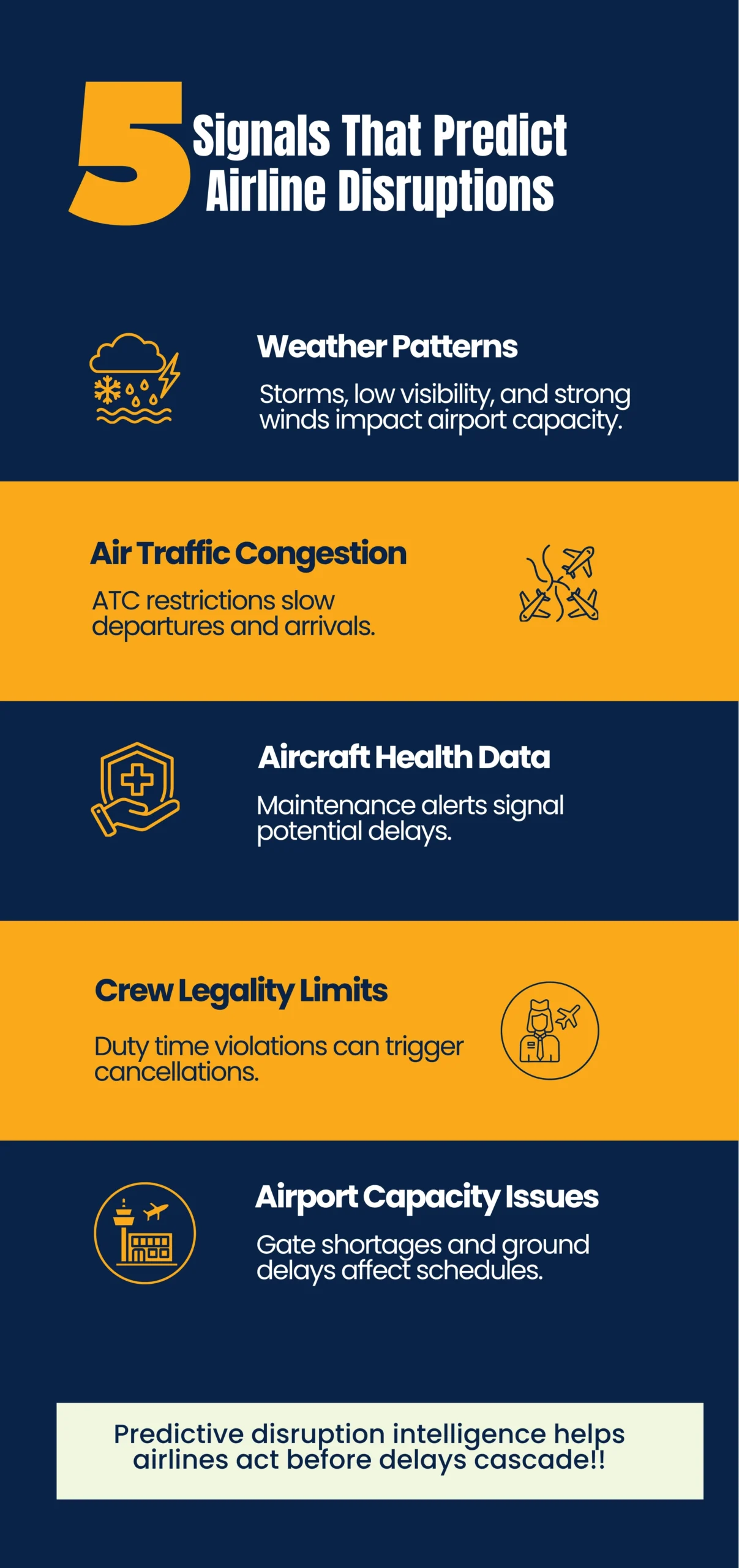
The infographic depicts five examples of major operational signals which often impact disruptions.
- Weather patterns – Icy/stormy weather reduces airport capacity and increases risk of delay or disruption.
- Air traffic congestion – Due to air traffic control restrictions/departure, arrival restrictions due to increased volume at busy hubs air traffic will slow.
- Aircraft health data – Mechanical/software problems or maintenance alerts/aircraft data will illustrate problems for possibly delayed flight.
- Crew legality Limits– Flight crew duty limits and rest period requirements prohibit some flight crews from flying scheduled flights due to legal limitations of operating hours.
- Airport capacity Issues – Due to crowded gates/ground delays there are longer than usual turnaround times for aircraft.
When these signals are analyzed together, airlines gain a comprehensive view of operational risk.
Innovative flight cancellation/delay prediction software constantly looks at these five signals to identify flights with a high risk of experiencing delays. This function gives airlines advanced notice to prepare for flight disruptions before they spread through the operational network.
The use of artificial intelligence to predict airport flight delays in real-time has dramatically changed the way we think about scheduling.
How AI predicts flight delays in real time
By evaluating inputs from various sources, such as real-time weather information, airport traffic, aircraft operational data and crew scheduling data all of which may be affected by weather, AI can identify patterns that human analysts may not be able to see.
For example, if the weather at an airport is degrading and there are inbound flights that have already been delayed, an AI model can look at the weather and predict that the outbound flights from that airport will have a high probability of missing their scheduled departure time.
By identifying these potential disruptions earlier in the scheduling process, airlines have more time to create contingency plans, as well as to alter or eliminate operations that may be negatively impacted.
A key component of the modern flight disruption management system is the use of predictive analytics, which allows airlines to manage and avoid flight disruptions, not just manage them.
How VoyagerAid uses AI to predict and Reduce Disruption Impact
Airlines can effectively pre-emptively manage disruptions to their operations through VoyagerAid’s integrated Predictive Disruption Intelligence solution. The solution continuously captures operational granularly and at a global network level, enabling it to provide early identification of pertinent operational conditions that could lead to a delay or cancellation of flight(s).
When a condition that poses a risk is identified, VoyagerAid highlights which flights are affected and outline how that risk will impact subsequent operations; i.e., aircraft rotation, crew assignment, passenger connectivity, etc. This early detection provides opportunities to proactively evaluate various recovery methods prior to the disruption impacting operational flows.
Incorporating predictive analytics with intelligent decision support, VoyagerAid allows operations teams to simulate various recovery methods directly within the integrated application, rather than performing manual comparisons on an exercise by exercise basis (i.e., comparing schedules and operational constraints). Recovery methods could include aircraft and/or crew swaps or schedule modifications, all contributing to the ongoing stability of airline networks.
Being a fully integrated airline disruption management system, VoyagerAid provides a comprehensive evaluation of recovery options, based upon numerous simultaneous operational considerations.
Aligning passenger Recovery with Predictive Intelligence
By predicting disruptions earlier, the airline industry is able to better serve their customers and provide more efficient recovery procedures. For example, by identifying potential delays before they occur, airlines can be prepared with alternative options for re-accommodating their customers.
With automated identification of affected passengers, airlines are able to create a plan for passenger rebooking/accommodation prior to the full impact of the disruption taking place. As a result, there is less last minute re-accomodation and better control over passenger flow.
Utilizing integrated predictive forecasting/breaks within a company, will allow them to make decisions about how to recover passengers that align with operational constraints, thus eliminating rebooking onto flights that will be robbed of their capacity later, due to mechanical or crew-related issues.
Developing a link between predictive analytical data and passenger workflows through VoyagerAid will provide a more efficient and effective recovery experience.
Improving Operational Visibility through Data and Analytics
VoyagerAid also offers analytics on disruption patterns to assist airlines with operational analytics beyond real-time forecasting.
Operational dashboards allow airlines to examine the following:
- Causes of delays and cancellations
- Recovery effectiveness by route or hub
- Operational bottlenecks affecting scheduling
- Passenger recovery timelines
These analytics provide airlines with the information needed to continuously improve their disruption management strategies.
As part of an airline management software ecosystem, these analytics change the way airlines approach disruption management from reactive to proactive through the use of data-driven operational knowledge.
Conclusion : Turning prediction into operation advantage
There will always be operational interruptions within the aviation industry. Weather patterns shift when weather systems change; an aircraft must be repaired if they require maintenance; unanticipated restrictions can affect air traffic flow due to regulatory changes. Resilient carriers are those who accurately anticipate or mitigate anticipated operational disruptions by using advanced technologies and techniques.
Airlines now have access to advanced predictive technologies that allow them to manage their responses to operational disruptions through proactive planning. By reviewing and monitoring potential indicators of operational problems prior to actual occurrences, carriers can implement recovery plans faster when an issue arises than they could using pre-existing procedures.
VoyagerAid is an integrated software solution designed to streamline a carrier’s ability to recover following any type of operational disruption. By consolidating Predictive Disruption Intelligence with other operational processes, VoyagerAid enables an airline to better identify potential causes of operational issues, thus allowing them to reduce and contain the impact of disruptions.
If a carrier can predict an operational disruption and take corrective actions prior to that disruption manifesting itself, it provides them the ability to manage their operational network without interruptions caused by delays.