

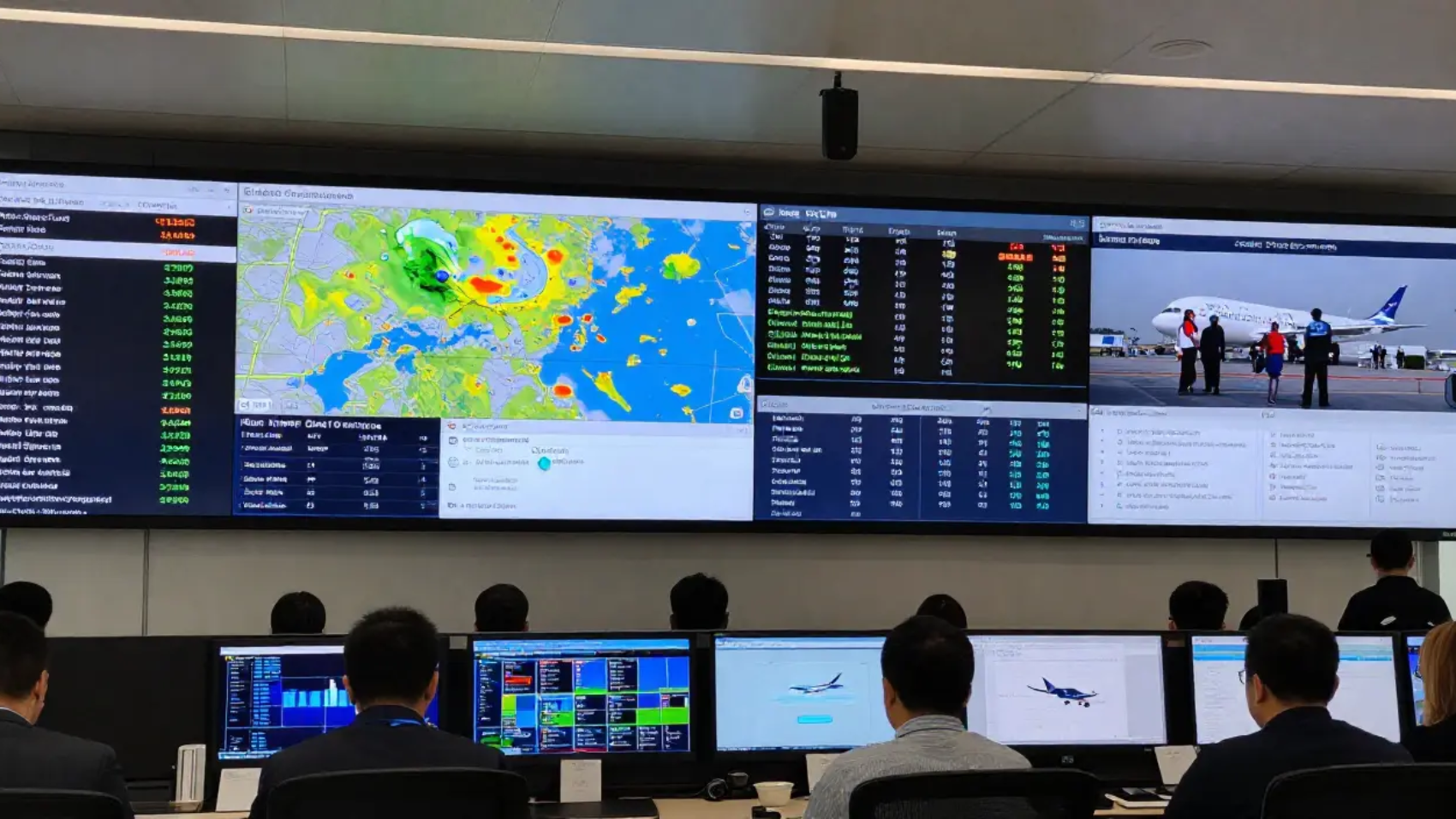
In the aviation industry, operational disruptions are a fact of life. Airline schedules are constantly being disrupted by factors such as unexpected weather changes, technical faults, crew availability, heavy air traffic, and airport restrictions. These interruptions sequentially cause delays, cancellations, and missed connections among a whole lot of other issues resulting in a rippling effect across the whole network
Airlines cannot totally avoid disruptions, but the extent of the impact of those disruptions varies from carrier to carrier. The exception is not a stroke of luck—it is the quickness, intelligence plus the recoveries’ coordination.
Airlines that suffer from disruptions are very seldom in that situation because of one failure. They are down because the disruptions unveil more profound operational challenges: uncoordinated systems, human decision-making and lack of visibility over passengers, aircraft, and crew. This is the point at which modern airline disruption management software – AI-enabled sets the trend.
The Reasons for Airlines Persisting with Operational Disruptions
Despite many years’ worth of investment in operational tools, a lot of airlines are still experiencing the same problems with disruptions. The reasons are of a structural nature rather than situational.
1. Complicated Interdependencies Throughout the Airline Network
Carriers’ operations function like a closely interlinked ecosystem. Just one disruption—a delayed arriving aircraft or a technical issue—could have a chain reaction:
- Aircraft rotations
- Crew duty schedules
- Airport slots
- Passenger connections
In the absence of complete visibility, the recovery choices taken in one place frequently cause issues in another. A minor delay may start but soon it can escalate into total disruption across the network.
2. Legacy Systems and Operational Silos
Still, there are a lot of airlines that depend on old systems that were made for stable schedules rather than dynamic disruption recovery. Operations, IT, crew management, and customer service already work in disconnected areas, each using different systems and data sources.
The fragmentation during disruptions leads to:
- Information flow being slow
- Conflicting decisions made
- Inconsistent messaging to passengers
- Coordination done manually increased
The absence of an airline disruption management system brings about a situation where recovery is slow, reactive, and error-prone.
3. Human Factors Under Pressure
Disruption recovery lies at the top of the list of most stressful operational scenarios. Decisions have to be made in a rush, most of the time under fatigue and time pressure.
Airlines still depend a lot on:
- Individual’s knowledge
- Manual review
- Informal sharing of knowledge
The quality of decision-making becomes variable as there is rotation of the teams and loss of expertise. Human judgment continues to be crucial but without the help of AI it cannot be scaled up during high-impact events.
4. External and Internal Constraints
Airlines are under constant pressure from the outside and from within the organization as well.
- External constraints are:
- Uncertain weather forecast
- Restrictions imposed by air traffic control
- Airports being full
Internal constraints are:
- Readiness of aircraft
- Legality of crew
- Pressure related to costs and resources
When there is only limited visibility, airlines have no alternative but to react instead of preparing, which consequently aggravates the impact of the disruption.
Why the traditional disruption management is no longer work
The models, which traditionally handled disruptions, were reactive. They reacted only after the delays had already been blown up, the passengers were already angry, and the resources were already overworked.
Manual processes could not be efficient in:
– Scaling during mass disruptions
– Aligning through various systems
– Making uniform decisions
– Keeping the communication clear and fast
Due to the rise of disruption in frequency and complexity, the airlines require more intelligent, quicker, and better-integrated recovery capabilities. For this reason, the industry is adopting the AI-powered airline disruption management solutions.
How AI Deals with Operational Disruptions
AI does not take over the airline expertise but rather, it magnifies it. The airlines by using AI to process massive operating data in real-time are able to shift their stance from reaction to anticipation.
One of the vital aspects of AI in this transformation is Predictive Disruption Intelligence.
1. Predictive Maintenance and Disruption Forecasting
AI frequently scrutinizes the health data of aircraft, operational patterns, and historical performance in order to detect the first signs of disruption.
This capability works as a flight delay predictor that helps the airlines foresee maintenance issues before they turn costly in terms of cancellations or network breakdowns. Acting sooner, airlines cut down on last-minute schedule changes and operational stress.
AI, like a flight delay and cancellation prediction system, allows airlines to predict flight delays more accurately, thus enhancing planning precision and recovery being prepared.
2. Smart Recovery Decision-Making
During crisis situations, the AI system evaluates several recovery scenarios at once and in no time. The airlines no longer have to depend on gut feeling or scattered data, they can choose by comparing cases like:
- Replacement of aircraft
- Postponement vs. cancellation
- Reassignment of crew
- Re-accommodation of passengers
Every option is evaluated in terms of:
- Practicality of operation
- Legalities concerning the crew
- Effect on the passengers
- Cost and impact on the network
The airlines’ intelligence solely ensures that they select the best implementable recovery option, not just the fastest response.
3. Smart Rebooking and Real-Time Passenger Communication
The operational decisions taken up, speed of execution becomes the new battleground.
AI is the only player in the Passenger rebooking and accommodation process, rebooking the affected travelers in a manner that is both efficient and fair. Moreover, at the same time passengers are being constantly updated through Real-Time Passenger Communication which cuts down the fear and uncertainty to a great extent.
The communication thread is supported by:
- Automated IROPS notifications
- A single, real-time airline notification system
- Accurate flight status alert notifications
By continuously informing passengers throughout the process, the airlines can reduce call-center and waiting area congestion.
4. Resource Optimization Across Aircraft and Crew
AI is an expert in aircraft and crew scheduling and it does it continuously, always ensuring that the recovery plans are operationally legal and realistic.
Crew duty limits, rest requirements, and multi-day rotations are validated automatically. This prevents recovery strategies that look good on paper but fail in execution.
Together, these capabilities strengthen the airline’s flight disruption management system, enabling faster, more reliable recovery.
VoyagerAid’s Three-Dimensional AI Approach to Disruption
What makes VoyagerAid different is that it sees the problem of recovery in three connected dimensions and not in one single problem.
1. Passenger Re-Accommodation
Passenger recovery is automated by VoyagerAid with intelligence and empathy. It helps with:
- Rebooking and compensation that are automated
- Prioritization that is aware of SSR
- Decision logic driven by policy
This allows for Airline passenger compensation management that is consistent and is in line with the requirements of modern Airline compensation management software.
2. Aircraft Swap Intelligence
VoyagerAid analyzes the availability of aircraft and the impact of the rotation on the network in real time. It evaluates swaps, delays, and cancellations to prevent cascading network disruptions while considering cost and feasibility.
3. Crew Legality and Availability
Crew recovery options are checked against duty limits and rest rules automatically. AI offers compliant recovery options while permitting manual intervention when necessary—thus ensuring that every plan is workable.
This integrated model grants VoyagerAid the capability to serve as a genuine airline disruption management system, instead of merely being a set of unconnected tools.
The Role of Artificial Intelligence in Recovering Effectively from Disruptive Events
Artificial Intelligence has the ability to integrate prediction, decision-making, communication, and execution. Airlines leverage AI to:
- Reduce Time to Recover from Disruptive Events
- Reduce Staffing Demands Associated with Disruption Recovery
- Increase Customer Confidence through Consistent and Compliant Service Delivery
- Provide Consistent and Compliant Service to Customers
The integrated nature of Voyager Aid as an airline management system provides a tool to meet the challenge of reuniting passengers who have experienced disruptions.
The Way Forward: Intelligent vs. Reactive Disruption Recovery
Disruptions will always be part of the aviation landscape, but how airlines deal with them can change over time. As technology evolves, airlines must abandon the time-consuming and cost-intensive Traditional Approach and implement Intelligent Control Approaches, which will allow them to develop disruption awareness prior to an incident, inform their decision-making, automate execution of those decisions, and deliver effective real-time communications to all affected stakeholders.
Voyager Aid provides Predictive Disruption Intelligence, Automated Rebooking and Compensation, Intelligent Recovery Decisioning, and Real-Time Communications to Passengers, Flight Attendants, and Pilots through an AI-driven Recovery System.
In today’s aviation climate, when time is critical, and customers’ trust is fragile, AI is no longer optional. It is the basis for developing Resilient, Scalable, and Customer-Centric Disruption Recovery Systems, and Voyager Aid will be at the forefront of developing these systems in the future.
luctus nec ullamcorper mattis, pulvinar dapibus leo.